ASSINATURA PRO COM DESCONTO

Hours
Minutes
Seconds

BLOG

The dispute between AI agent vs. generative AI This marks a new era in Artificial Intelligence. While previously the focus was on GenAI and its creative capabilities, today the emphasis is on autonomy and operational efficiency in business environments.

The confusion, however, persists: many startups leaders and product managers still treat AI Agent and Generative AI as synonyms or competing technologies.

For those seeking not only to optimize processes, but also reshaping entire business ecosystems, It is crucial to master the fundamental distinction in the clash. AI agent vs. generative AI.

The central thesis is unequivocal and strategic: Generative AI, while revolutionary for its ability to reactively produce text, code, or images, is a fundamental tool in itself. prompt Simply put, it is, in fact, a critical component who resides within of the architecture of an AI Agent.

Generative AI (GenAI): The Cognitive Engine of Creation
Generative AI (GenAI) The Cognitive Engine of Creation

For entrepreneurs or CTOs, generative AI should be seen as the creation tool.

Its primary function is to Transforming input data into new and coherent output content., based on patterns it has learned from vast datasets (Details about GenAI can be found in IBM and AWS).

The success of models like GPT, LaMDA, or Bard lies precisely in their ability to generate solutions, whether by writing a persuasive email, drafting code, or creating a conceptual image from a textual description.

This generation capability has profoundly impacted the job market, optimizing creative and repetitive tasks on a large scale (Check out the...). Impact of AI on the Global Job Market).

Definition and Classic Use Cases

GenAI essentially operates in a mode reactive. She is waiting for an instruction (the prompt), processes it internally and returns the result.

Its architecture is centered on the Large Language Model (LLM) or diffusion models (for images), its intrinsic value being... fluidity and the coherence of production.

In a business context, use cases are mostly of digital asset production:

  1. Content Creation: Generating blog articles, social media posts, or copy for advertising, significantly accelerating the marketing cycle, as detailed by Content Marketing Institute on GenAI.
  2. Code Generation: Assistance in writing functions, language conversion or debugging, transforming the LLM into a development co-pilot.
  3. Analysis and Summarization: Processing lengthy legal documents or financial reports, summarizing the key points concisely.

The Myth of Autonomy: Limitations of GenAI

The biggest misconception is expecting Generative AI to be capable of... act Alone in the real world, a pure GenAI cannot, for example, conduct market research, analyze the results, decide on the best launch strategy, and execute the social media post, all in sequence.

It lacks four fundamental elements that define autonomy:

  1. Persistent and Contextual Memory: Generative models typically have a limited context window. They "forget" previous interactions unless explicitly fed with history.
  2. Access to External Tools: GenAI, on its own, cannot navigate the internet in a structured way, interact with third-party APIs (such as a CRM or a payment platform), or use a code editor outside of the environment of [the relevant platform/service]. prompt.
  3. Multi-Stage Planning: She is limited to responding to immediate task. If the goal is "to increase sales in 10% in the next quarter," GenAI needs to manually break down that goal into steps (research, analysis, creation, execution).
  4. Feedback Loop: It lacks an inherent mechanism to self-evaluate the outcome of its actions in the environment and subsequently correct the plan.

This is where understanding AI infrastructure becomes crucial, as it forms the basis for scaling the capabilities of core models.

To delve deeper into the technical basis that underpins these tools, we recommend reading about... What is AI infrastructure and why is it essential?.

Architecture diagram showing Generative AI (LLM) nested within an AI Agent, illustrating that GenAI is a component and not the complete system.

Agent AI vs. Generative AI: Unveiling the Proactive Agent Architecture

The real disruption for the business world lies in AI Agency (or AI Agent), which represents a leap from creation for the action.

The Agent is, conceptually, a software system that perceives its environment through sensors, processes this perception, makes decisions, plans and executes actions through actuators (tools) (For a detailed definition, see the...) AWS's explanation of AI Agents.).

Agent-based AI vs. generative AI It's not a duel, but rather a symbiotic relationship.

While Generative AI is the muscle that performs the generation of complex content or reasoning, the AI Agent is the autonomous pilot that defines the route, monitors traffic, and adjusts the speed.

The Action Loop: Perception, Reasoning, Planning, and Action

The architecture of an AI Agent operates in a continuous cycle, known as the "Action Loop" or O-OODA (Observe, Orient, Decide, Act – Adapted for AI).

This cycle ensures autonomy and self-correction capabilities, elements that are lacking in pure GenAI:

  1. Perception (Observe): The agent collects data from the environment (emails, sales data in a CRM, API notifications, web search results).
  2. Reasoning (Orient & Decide): Using its LLM (an internal GenAI), the Agent processes the target and perceived data, generating a logical plan. This is where the generative engine comes in. translate The state of the world in a sequence of actions.
  3. Planning (Plan): The agent breaks down the complex goal into executable subtasks (Example: "To achieve X, I first need to do A, then B, and only then C").
  4. Action (Act): The agent uses external tools (APIs, browsers, databases) to execute the plan in the real world.
  5. Adaptation (Feedback Loop): The agent evaluates the outcome of the action and uses the feedback to refine the next Perception/Reasoning cycle, ensuring learning and self-correction.

The Key Components of an AI Agent (LLM, Memory, Tools)

To function, an AI Agent needs more than just a powerful LLM (GenAI). It requires a robust data structure and functionality (Source: Google Cloud Generative AI Glossary).

  • Large Language Model (LLM): Acts as the brain of the system, responsible for reasoning, planning, and generating the language that guides actions and interactions. It is the generative motor. The constant evolution of these models (such as the Grok, Gemini or ClaudeThis is what drives the Agents' power.
  • Memory (Buffer/Persistent): It stores the history of the interaction (short and long term) and the state of the world that the agent perceived. This prevents repetition and ensures the continuity of planning.
  • Tools/Plugins: These are the interfaces to the outside world. They can be APIs, specific code functions, or the ability to interact with No-Code platforms to, for example, update a table in a database or send a notification via Slack. Frameworks such as LangChain and CrewAI They are crucial to this orchestration.

Strategic Integration: Why GenAI is Essential for the Agent

The main difference between AI agent vs. generative AI It's not technological, but architectural and functional. GenAI is the engine. The Agent is the complete orchestra that uses that engine.

LLM, with its generative capabilities, is what transforms the AI Agent into an intelligent system, and not just an automaton based on rigid rules.

The power of the LLM lies in its ability to reasoning in natural language.

LLM as the 'Brain' of Reasoning (Plan Generation Mechanism)

When an AI Agent receives a goal (example: “Find 5 leads in the sector of Fintech in São Paulo and generate a contact report”), the internal LLM is called in for the reasoning phase.

He not only creates a text, but Create the action plan. which leads to the goal, using language as its means of calculation.

The LLM thinks:

  1. I need the 'Web Search' tool to find contact information for Fintech companies in São Paulo.
  2. I need the 'Data Validator' tool to filter out valid emails.
  3. I need the 'Report Generator' tool (also GenAI) to format the final report.

It is generative capacity to produce this logical and operational chain that differentiates the AI Agent from a chatbot common or simple workflow automation. Studies on Agent-Based Reasoning on ResearchGate They demonstrate this power.

The complexity of reasoning in generative AI is a field of intense academic study (Read more at SciELO on the topic).

No-Code Automation with AI Agents: From Theory to Practice

For the No Code Startup community, the adoption of AI Agents is a game-changer. Traditionally, No-Code/Low-Code simplified the creating interfaces and flows.

With Agency AI, the focus shifts to creating autonomous intelligence which uses these flows intelligently.

Consider a Customer Service Agent. They not only generate responses (GenAI's task), but also:

  1. Understand The customer's message (via the chat API).
  2. Think Regarding intent (LLM).
  3. Plan the action (Ex.: If it is bug, Create a ticket in Trello; if it is sale, (send payment link).
  4. Action (Interacts with Trello API and Stripe API).

This level of autonomy, built upon the foundation of AI agent vs. generative AI (Understanding GenAI as an engine), it allows startups to develop complex functionalities without writing hundreds of lines of code.

It is the union of AI Coding Training: Create Apps with AI and Low-Code with the power of agentic frameworks, allowing the construction to be focused on business logic and not on syntax.

Interface of a No Code development environment showing the configuration of an AI Agent with blocks for "Perceive", "Reason (LLM)" and "Action (API)".

The Future: Real-World Use Cases and the Market Shift

The market trend is clear: Agency AI will be the main driver of exponential growth in the coming years, moving the market value of... tools creation for systems execution.

The difference between AI agent vs. generative AI It's the difference between having a powerful engine and having a self-driving car.

Applied Examples in Startups

The value of AI agents becomes apparent in contexts where task complexity and the need for interaction with the real world are high:

  • Proactive Data Analyst: Instead of just responding to one prompt Regarding the data (“What was the profit last month?”), a proactive AI Agent has the goal of “Optimizing Customer Acquisition Cost (CAC)”.

    It can monitor ad spending in real time and automatically analyze the... funnels conversion tracking, detecting anomalies (using LLM for reasoning), and autonomously pausing low-performing campaigns via the ad platform's API.
  • Independent Sales Agent: An agent who receives a list of leads, uses GenAI to customize the pitch The contact system sends the email via a No-Code system, monitors the open rate, and, if there is interest, automatically schedules a meeting in the salesperson's calendar, updating the status in the CRM.

    For more details on the application in sales, see the Gartner's analysis of Autonomous Selling with AI.
  • Content Sourcing Agent: The agent monitors industry news, uses GenAI to summarize the content and rank it by relevance, and then autonomously publishes a summary in the internal community or on the blog (after human review), keeping the ecosystem always up-to-date.

How to Start Building Agents with Low-Code/No-Code

Adopting AI Agents doesn't require a team of PhDs in Machine Learning. The synergy between Low-Code/No-Code and LLM APIs (the generative engine) makes building agents accessible.

Modern No-Code platforms already offer connectors and tools to create the loop of perception and action:

  1. Define the Goal (and the KPI): Start with a clear and measurable goal (e.g., Reduce the average support response time in 20%).
  2. Identify the Tools: Map out the systems that the Agent needs to use (email, Slack, database, Trello).

    The integration of AI with Robotic Process Automation (RPA) is an accelerating factor (See The role of RPA in the era of Agency AI.).
  3. Use LLM as a Reasoner: Configure LLM (GenAI) to translate the world state and the goal into a flat logical way of using the tools.

The focus should be on rapid and iterative implementation, a central characteristic of the No-Code Startup philosophy.
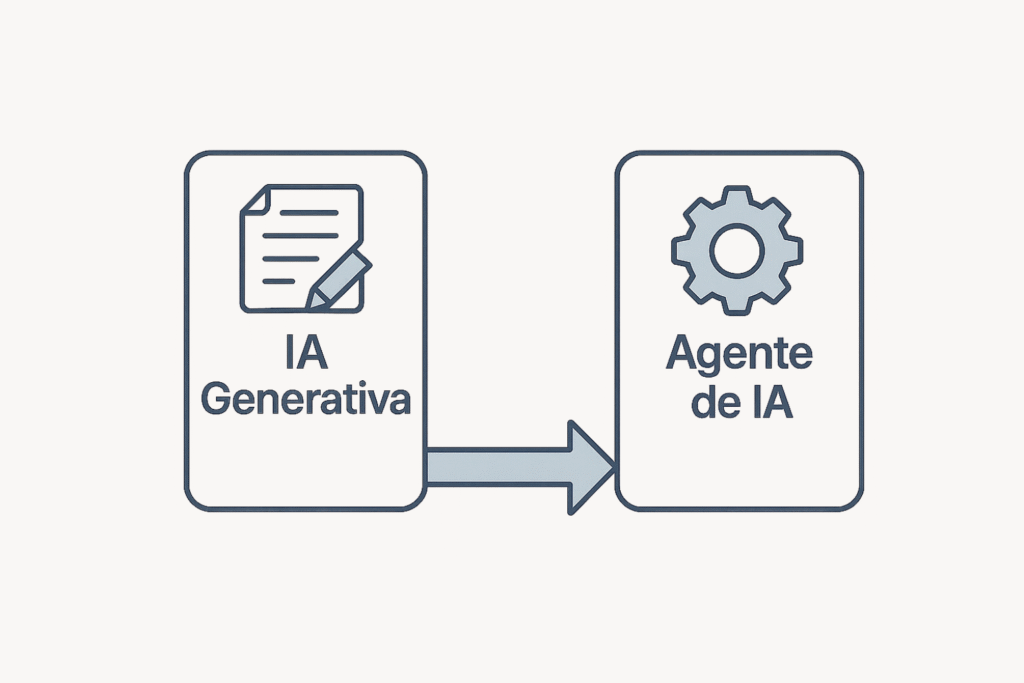
Graphical representation of AI advancement, showing a timeline where Generative AI (Creation) precedes and enables the AI Agent (Autonomous Execution).

Strategic Implementation for Startups: The No Code Startup Path

The decision to invest in an AI Agent is fundamentally a strategic decision regarding the allocation of time and resources.

For the No Code Startup, the question agent of pathway or generative pathway It is crucial for optimizing business processes with AI.

GenAI optimizes production. The AI Agent optimizes the value stream complete.

Agent Adoption and Process Optimization

The successful implementation of Agency AI begins with identifying process bottlenecks that are too complex for simple rule-based automations (If This, Then That), but they still consume human time.

The crucial difference of an AI Agent is that it can adapt to unforeseen scenarios within an overall goal.

For example, in the Human Resources sector, an Agent can:

  • Analyze resumes (GenAI).
  • Compare with the job description (LLM reasoning).
  • Schedule interviews (Action via Calendar API).
  • Send technical tests (Action via testing platform).
  • And if the candidate does not respond, send a reminder (Adaptation based on feedback loop).

No Code Start Up offers robust solutions for companies seeking this level of proactive automation, through AI and Automation Agents: No-Code Solution for Businesses.

Challenges and Governance of Agency AI

Despite its potential, Agency AI presents unique challenges, primarily related to control and security.

Autonomy means that the agent can, on rare occasions, generate unintentional actions ("action hallucinations").

Governance should focus on:

  1. Sandboxing: Limit the scope of tools that the Agent can access and use.
  2. Human Supervision: Ensure that the Agent requests "permission" for high-risk actions (e.g., making a financial transaction or sending mass communications to clients).
  3. Transparency of Reasoning: The agent must be able to explain the why of their actions (the chain of thought (generated by the LLM), facilitating auditing and correction. The ethical debate surrounding AI autonomy is central (Read about Ethics in Autonomous AI Systems).

Agency AI is a journey, not a destination. Its implementation should be phased, starting with low-risk processes and gradually expanding as trust in the system and maturity increase. agency AI architecture They increase.

Representation of a gear with a brain in the center, symbolizing the autonomous and reasoning system of Agency AI.

Frequently Asked Questions (FAQ)

What does Agency AI mean?

Agency AI refers to Artificial Intelligence systems that have the ability to perceive an environment, make autonomous decisions, plan a sequence of actions, and execute them in the real world (usually via APIs and tools).

Unlike reactive generative AI, the AI Agent is proactive and works continuously towards a long-term goal, adapting its plan based on the results of its actions.

Will Generative AI be replaced by AI Agents?

No. Generative AI will not be replaced, as it is a essential component The AI Agent. GenAI, specifically the LLMs, acts as the Agent's reasoning and communication engine, being responsible for interpreting data, creating action plans, and generating the interface text or code necessary for the tasks.

GenAI is the cognitive engine; the AI Agent is the autonomous execution system.

What are the main practical differences in usage between the two AIs?

The practical difference is that GenAI requires a prompt for each step and cannot interact with external systems without manual intervention.

The AI Agent can be given a high-level goal (e.g., "Monitor Twitter and notify me of brand crises"), and it will autonomously execute all the steps: research, analysis, classification (using GenAI), and notification (using external tools).

GenAI is a creation tool, while the AI Agent is a autonomous automation system. For further information, see the Practical difference between GenAI and Agents
Where can I build an AI agent without needing complex code?

Where can I build an AI agent without needing complex code?

You can build proactive AI systems using Low-Code and No-Code platforms that offer direct integrations with LLM APIs (OpenAI, Google, Anthropic) and connectors for business tools (CRM, ERP, databases).

These platforms allow you to visually map the loop of Perception, Reasoning (GenAI) and Action, focusing on business logic, not programming complexity. The era of simple content generation is ending, giving way to the era of... autonomous execution.

Understanding the hierarchy AI agent vs. generative AI It is the compass for any leader who wants to build a product or optimize an operation in a scalable way.

Generative AI is incredibly powerful, but it's only half the equation; it needs the agentic architecture to interact, adapt, and, fundamentally, deliver value continuously in the complex environment of a business.

The future doesn't belong to those who only know how to generate content, but rather to those who know how to build intelligent systems that... act for the business.

To take the next step and transform this architecture into real, scalable, and functional products, we invite you to explore the... AI Coding Training From No Code Startup, master the art of creating AI solutions without code. who think and act.

Hi everyone! In the last few days, a piece of news has been causing quite a stir and generating a lot of questions: "WhatsApp Business will ban AI chatbots".

Many people became concerned, asking if they would no longer be able to use it. AI agents (Artificial Intelligence) for sales or customer support. So, how will this impact businesses?

The good news is that the reality is quite different from what the alarmist headlines suggest. I'll delve deeper into the subject and clarify everything for you.

WhatsApp Business announces new rules for the use of AI.

Understand what will change in WhatsApp.
Source: No-Code Startup Channel

The news was initially reported by the portal. TechCrunch, who did a great job contacting Meta directly to validate all the information. This is important because we've seen other outlets with more aggressive headlines, which ended up generating unnecessary panic.  

The truth is that there has been a change in the terms of use, but the impact is much more specific than it seems.  

What changes with the ban on generic chatbots?

WhatsApp will block ia
Source: No-Code Startup Channel

The main target of this new rule is chatbots. general use. Think of AIs like Luzia or even... ChatGPT, which you can add on WhatsApp and ask about literally anything, from a cake recipe to the history of philosophy.  

These types of AI, which function as broad virtual assistants, compete directly with Meta's own solution, Meta AI. It is precisely this usage model that WhatsApp is trying to restrict on its platform.  

Direct impact for those who use AI in customer service and support.

End of AI on WhatsApp
Source: No-Code Startup Channel

Now, the most important part: if you use AI for a specific function in your business, you can breathe a sigh of relief.

Meta itself made it clear that the change It won't have an impact. Businesses that use artificial intelligence to provide customer service or support. For example, a travel company that uses a bot to help customers with their bookings will not be affected in any way.  

Therefore, if you use a AI agent Whether it's for a business transaction, providing your service, or offering support, nothing changes for you.  

Why are OpenAI and other providers being affected?

WhatsApp Business will block agent.
Source: No-Code Startup Channel

OpenAI is already a clear example of the impact of this change. They themselves announced that the number that allowed direct communication with ChatGPT on WhatsApp will stop working.  

This happens because OpenAI and other companies offering general-purpose AI are seen as direct competitors of Meta within its own ecosystem. This measure is a way to protect and prioritize Meta AI.  

What is still allowed in WhatsApp Business with AI?

The question remains: what is still allowed? The answer is simple: all AI usage that has a specific and commercial focus.

You can continue using AI to provide customer service, conduct sales processes, offer technical support, or any other activity directly related to your business. The restriction only applies to generic AIs that do not have a defined function.  

A complete analysis of the changes and what to expect from 2026 onwards.

This new policy comes into effect as of 100% January 15, 2026. In my analysis, this is a move that directly competes with Meta.  

Ultimately, WhatsApp belongs to them, and they are using their position to create a more favorable environment for their own product. It may seem like unfair competition, but they dictate the rules of the platform.  

In short, the change is real, but the impact is much more niche than it seems. It's not the end of business chatbots, but rather a clear definition of what Meta wants on its platform.

If you want to learn how to create focused, professional AI agents that are fully compliant with the new regulations, you are invited to check out... AI Agent Manager Training 2.0.

AI agent course Norcode startup
Source: No-Code Startup Channel

The technological landscape is witnessing a seismic shift that transcends the capacity for content creation.

Following the widespread popularization of Generative AI, the dominant theme in 2025 and 2026 shifts from "speaking like a human" to "acting like a human," defining the next frontier in intelligent systems: AI Agency.

For a founder looking to build a profitable MVP at low cost, or for a professional seeking automations that will set them apart in the company, understanding the main... AI agent trends for 2026 It's not just strategic; it's fundamental to business survival and scalability.

AI agents are software systems designed to operate autonomously, interacting with complex environments using external tools. (APIs, databases) and making multi-step decisions to achieve specific goals without constant human supervision.

They represent the pinnacle of automation, transforming reactive tasks into proactive missions.

This article explores the roadmap to success in Agencia, detailing the AI agent trends for 2026 and offering a clear path for those who use the No-Code ecosystem to innovate.

Abstract illustration depicting the transition from a static AI assistant (chatbot) to a dynamic autonomous agent.

Why is 2026 the Tipping Point for Agency AI?

The market is in a state of effervescence, but also of consolidation. Independent agents are moving from the experimental phase to practical application, requiring entrepreneurs and technology professionals to understand the difference between promise and reality, as analyzed by IBM.

In 2025, the focus shifted from solely the architecture of the LLM (Large Language Model) to concentrating on... agentic framework that surrounds it, allowing AI not only to reason, but also to perform actions.

The Transition from Content Creation to Autonomous Action

Historically, AI tools, such as chatbots Or reactive virtual assistants, they were limited to immediate responses and single-step tasks.

The new generation of AI agents — classified as Goal-Based or Utility-Based Agents — are equipped with memory, planning capabilities, and the functionality of tool-use (use of tools).

This is the key differentiator that interests the No-Code world: the ability to integrate with platforms like Airtable, Zapier, or Webflow to, for example, manage a sales pipeline The entire process, from prospecting to sending emails, is handled without the need for human intervention at each stage. The agent essentially becomes a... digital collaborator.

The crucial innovation lies in task decomposition capability. Where previously a Founder needed a complex sequence of Zaps to simulate decision-making.

A utility AI agent can break down a high-level objective (“Increase user engagement”) into concrete and dynamic actions (“Analyze usage data”, “Generate blog content”, “Schedule posts”, “Analyze campaign results”), autonomously using the (internal) data analytics platform and the (external) CMS.

Exponential Growth: Market Projections and the Risk of Inertia

The market projects massive growth, but with important caveats. Gartner, for example, predicts that the maturity of Agency AI will be a determining factor.

Although the hype is high, the same projection This indicates that more than 40% of agency AI projects may be cancelled. by the end of 2027 due to poor governance, ethical failures, or inability to prove Return on Investment (ROI) in mission-critical applications.

This raises a crucial warning for professionals: the focus should be on solutions that solve the problem. real pains with sound governance, ...and not in technologies that are merely "legal".

Market growth projection chart for intelligent systems and autonomous AI agents until 2026.
Market growth projection chart for intelligent systems and autonomous AI agents until 2030.

To mitigate the risk of failed projects, the No Code Start Up advocates for an iterative approach, starting with simple automation MVPs and scaling to more complex agents.

The promise is not the replacement of human capital, but the radical optimization of productivity.

This is the ideal time to invest in training skills that enable the construction of AI agents, especially through low-code approaches or low-code, which facilitate control and rapid validation, as we teach in our AI Coding Training: Create Apps with AI and Low-Code.

The 5 AI Agent Trends for 2026 That Are Redefining Work

To the AI agent trends for 2026 They converge on a central point: artificial intelligence will become invisible, embedded in workflows and business processes.

The most valuable applications will be those that integrate seamlessly with existing work platforms, freeing up time for strategic human decision-making.

Trend 1: The Rise of Specialized Agents (Vertical Integration)

The next generation will not consist of generalist agents, but rather of intelligent systems. verticalized — AIs trained specifically for a single domain function (e.g., Compliance Agent, Lead Generation Agent, Inventory Optimization Agent).

The concept of Vertical AI Agent, on the rise, demonstrates that a Founder SaaS, for example, can develop an "Onboarding Agent" that monitors product usage by new customers, identifies adoption bottlenecks, and proactively sends out customized tutorials or schedules support meetings, all via No-Code tool APIs.

Specialization solves the problem of unpredictability in general-purpose AI and offers a measurable ROI.

For the CLT In a finance department, an "Audit Agent" monitors anomalies in large volumes of transaction data (using techniques of AI for no-code data analysisThis becomes an indispensable tool for ensuring compliance and safety without the burden of manual analysis.

Trend 2: Multimodal Agents and the Domination of Context

AI agents in 2026 will not be limited to processing text. The ability to process, reason, and act based on multimodal data (text, image, video, audio, tabular data) will be standard, with the Multimodal AI becoming the standard interface in intelligent systems.

An independent e-commerce agent, for example, will be able to analyze a product image sent by the customer, cross-reference this information with the text of a complaint and the inventory database, and automatically generate a return label and a discount voucher.

Contextual mastery is what defines true autonomy; the more data and data types an agent can integrate into its multi-step "reasoning," the more effective and "human" it becomes in its decisions.

This minimizes so-called "action hallucinations," where the AI executes incorrect or inefficient steps due to a lack of contextual information.

Visual representation of an autonomous AI agent using multiple tools (calendar, email, database) to perform a complex, multi-step task.

Trend 3: Democratization via No-Code and Low-Code

This is perhaps the most relevant trend for the community. No Code Start Up. Complex agentic development frameworks, which previously required PhDs in data science and engineers... machine learning (ML) are being encapsulated in accessible platforms.

Low-code, in particular, offers the perfect balance: it allows professionals to build customized agents with visual interfaces (facilitating validation and keeping costs low) while simultaneously inserting small blocks of code to ensure control over mission-critical logic.

Tools and Practical Applications for the No-Code Entrepreneur

The proliferation of platforms that enable the creation of agentic workflows (such as the advanced use of workflows no Make/Integromat, or tools dedicated to agents like LangChain/Flowise in wrappers No-Code allows an entrepreneur to:

  1. Validate an Agent MVP: Build a prototype of an automated service (e.g., an agent that monitors a competitor's price and adjusts its own in real time) in a matter of hours.
  2. Reduce the Time-to-MarketThe development time for an in-house AI assistant for a B2B agency, for example, drops from months (traditional development) to weeks.
  3. Increase Corporate Productivity: O professional They are able to implement departmental automation (HR, Finance) without relying on the IT team, raising their performance to outstanding levels and justifying a promotion.

Take the opportunity to explore the Leading Low-Code AI Agent Builders available on the market.

Trend 4: The New Market Logic — Collaborative Agents (Swarm AI)

To the AI agent trends for 2026 They point to the end of the lone agent.

The real innovation lies in the architecture of "Swarm AI" or collaborative agents, where multiple AIs, each specialized in a task (e.g., a Research Agent, a Writing Agent, a Reviewing Agent), work together in a pipeline.

For a Freelancer For those seeking to optimize the delivery of their services, this collaboration means:

  • Speed: A project to generate reports that would take a day can be completed in hours.
  • Quality: The specialization of each agent ensures that the final result is reviewed, corrected, and optimized in their respective areas, resulting in a final product of greater value and authority.

This architecture converges on the concept of 'Agentlakes' architecture and Modular AI, where platforms manage and orchestrate multiple agents.

Flowchart showing a collaborative agent system (Swarm AI) with specialized AIs (Researcher, Planner, Executor) working together.

Trend 5: Focus on Real-Time Monitoring and Optimization Agents

In 2026, the most valuable agents will be those who operate silently, continuously monitoring and optimizing business systems.

Instead of simply responding to a command, a marketing campaign optimization agent, for example, will make infinitesimal adjustments to the budget., target and creative advertising in real time, maximizing conversion.

THE Real-Time Optimization (RTO) AI-assisted technology is fundamental for manufacturing, logistics, and finance. This is gold for... Founder which seeks scale, as it transforms the uncertainty of optimization into an automated and continuous science.

While the human team focuses on high-level creative strategy, autonomous agents ensure that the operational engine is always running at maximum efficiency.

This type of complex automation is what defines the success of the new generation of companies, requiring that even B2B agencies seek NoCode solutions for businesses. and train your employees on these tools.

Reliability and Security: The Challenge of Agency Governance

Although AI agent trends for 2026 They promise revolutionary autonomy, but the critical tipping point is trust.

IBM highlights that market expectations for 2025 are in conflict with technical reality, especially with regard to... safety and ethics of agents.

THE Building a Robust AI Governance Framework by 2026 It is essential to mitigate risks.

The Myth of Total Autonomy and the Problem of Action Hallucination

Hallucination is a common term in Generative AI, but in AI agents, it manifests as a action hallucination, where the agent plans and executes a sequence of steps that seem logical, but are ineffective or catastrophic in the real environment.

This may result from prompts ambiguous, incomplete data, or flaws in the planning module.

For this reason, the Salesforce emphasizes the importance of building Trusted AI Agents., which include checkpoints human supervision, defined limits of action, and the ability to reverse processes.

O MIT Tech Review highlights the ethical and technical challenges of autonomous agents., highlighting that, in critical applications, human supervision (the human-in-the-loop) must be maintained.

The debate about How to use Artificial Intelligence ethically. in companies requires that the professional A company that implements automation should ensure its system is transparent, recording every decision and action taken for audit and accountability purposes, in alignment with... emerging legislation such as the European Union's AI Act.

Illustration of a digital brain being monitored by a human eye, representing the concept of "human in the loop" in AI systems.

The Urgency of Tool-Use Framework and Reliable APIs

The ability of the AI agent to use external tools (APIs) is what makes it powerful, but also vulnerable.

An agent is only as good as the set of the tools that are provided to it. The companies that will dominate the market in 2026 will be those that invest in frameworks Robust frameworks that not only integrate the LLM but also validate, protect, and limit AI's interaction with the outside world, directly addressing the crucial issue of AI security.

This manifests itself in the No-Code world through the careful selection of platforms with strong API support, granular permissions, and... logs detailed execution instructions.

The Strategic Roadmap: How Professionals Should Act Now

The window of opportunity to dominate the AI agent trends for 2026 It's open. Inertia now could mean a very high recovery cost in the coming years, when Agency AI becomes a competitive prerequisite in any niche.

For the Founder: Market Validation and the Agency MVP

If your dream is to create a profitable SaaS and secure financial and geographical freedom, the fastest path to a successful MVP is through Agency AI.

Don't try to build a product based on complex code that takes months and drains capital. Instead, focus on:

  1. Solving a Specific Pain Point: Use Agency AI to automate your customer's most complex pain points (e.g., ultra-segmented prospecting, first-level technical support).
  2. MVP with Low-Code: Use No-Code and Low-Code platforms to orchestrate the agent. This allows you to iterate quickly and collect data. feedback Get a realistic market analysis and validate the profitability of the idea with minimal investment.
  3. Focus on Scale: AI agents inherently offer unlimited scalability potential. An agent that handles 100 customers today can handle 10,000 tomorrow without significant marginal cost, solving the scaling pain point that many founders face.
A smiling Founder looks at a dashboard displaying growing business metrics driven by AI automation.

For Professionals: Automation of Critical Processes and Internal Recognition

Professionals who master the construction of intelligent systems will become indispensable in any company.

If you're looking for a promotion and higher income, the ability to automate and innovate without relying on IT teams is your greatest asset.

  1. Identify bottlenecks: Map out the most repetitive, time-consuming, and error-prone processes in your department (e.g., monthly reports, data reconciliation, project management).
  2. Build the Internal Agent: Use low-code tools to build agents that resolve these bottlenecks. This is your "showcase project".
  3. Prove the ROI: Document the time savings and error reduction. Presenting a functional autonomous agent that boosts your team's corporate productivity is the strongest argument for career progression and salary increases.

    Autonomous innovation: instead of asking, you deliver.

FAQ: Essential Questions About Independent Agents

1. What is the difference between an AI agent and a traditional chatbot?

A chatbot is fundamentally reactive and limited to conversations. It processes text and generates responses in a single-step interaction.

An AI Agent (or Autonomous Agent), on the other hand, is proactive, has memory to maintain the state of the environment, possesses a planning module to break down an objective into multiple steps, and is capable of executing actions in the real world (using APIs or tools).

To achieve this goal without constant human intervention, the key is autonomy and the ability to take multiple steps.

2. Will AI agents replace human jobs by 2026?

No, the complete replacement of human labor is not the AI agent trends for 2026, but rather a redefinition of work.

AI agents will replace repetitive, rule-based, and data-intensive tasks.

This frees up professionals' time to focus on activities that require creativity, ethical decision-making, negotiation, and cultural context—essentially human skills that intelligent systems, however advanced, still cannot reliably replicate.

3. What is the risk of hallucination in autonomous agents and how can it be avoided in No-Code?

The risk of hallucination (both in content and action) is real. To minimize it, the best strategy is to restrict the agent to a set of tools and data strictly limited to their area of expertise.

In a No-Code/Low-Code environment, this means:

  • Use checkpoints Validation steps (mandatory stops for human review before a critical action, such as sending a mass email or a financial transaction).
  • Provide the maximum of context via well-structured databases (Airtable, Sheets).
  • Thoroughly test the agent in an environment of sandbox before releasing it for production.

Taking the Leap to Autonomy

To the AI agent trends for 2026 It's clear: the autonomy of software is becoming the new currency of value in the global market.

What was once science fiction is now an accessible reality thanks to the democratization brought about by the No-Code and Low-Code movements.

Success in the coming years will depend not only on the technology you use, but also on your ability to orchestrate intelligent systems that work for you.

This is your time to act.

If you are a Founder looking for the next profitable SaaS idea or a professional determined to revolutionize your department and secure your career advancement, don't waste any time.

Mastering Agency AI via No-Code is the most strategic shortcut; learn how to build these intelligent systems from scratch and secure your future in the market.

Sign up for the AI Coding Training: Create Apps with AI and Low-Code and position yourself among the first to reap the rewards of the Age of Autonomous Action.

THE Artificial Intelligence as co-pilot It's not just a tool, but a fundamental shift in the work paradigm. It represents a transition from... automation for the increase, enhancing human capabilities to unprecedented levels.

This technology acts as an advanced virtual assistant, utilizing Large-Scale Language Models (LLMs) and... Generative AI (IAG) to provide contextualized support, insights and content generation, whether it's code, design, or text.

The direct impact of this collaboration is felt in the optimization of time and the reduction of technical barriers, making it an indispensable catalyst in the world of... Low-Code and No-Code.

The professional who masters interaction with the AI as co-pilot It becomes an agent of transformation with the potential to execute, in hours, what previously took days or weeks.

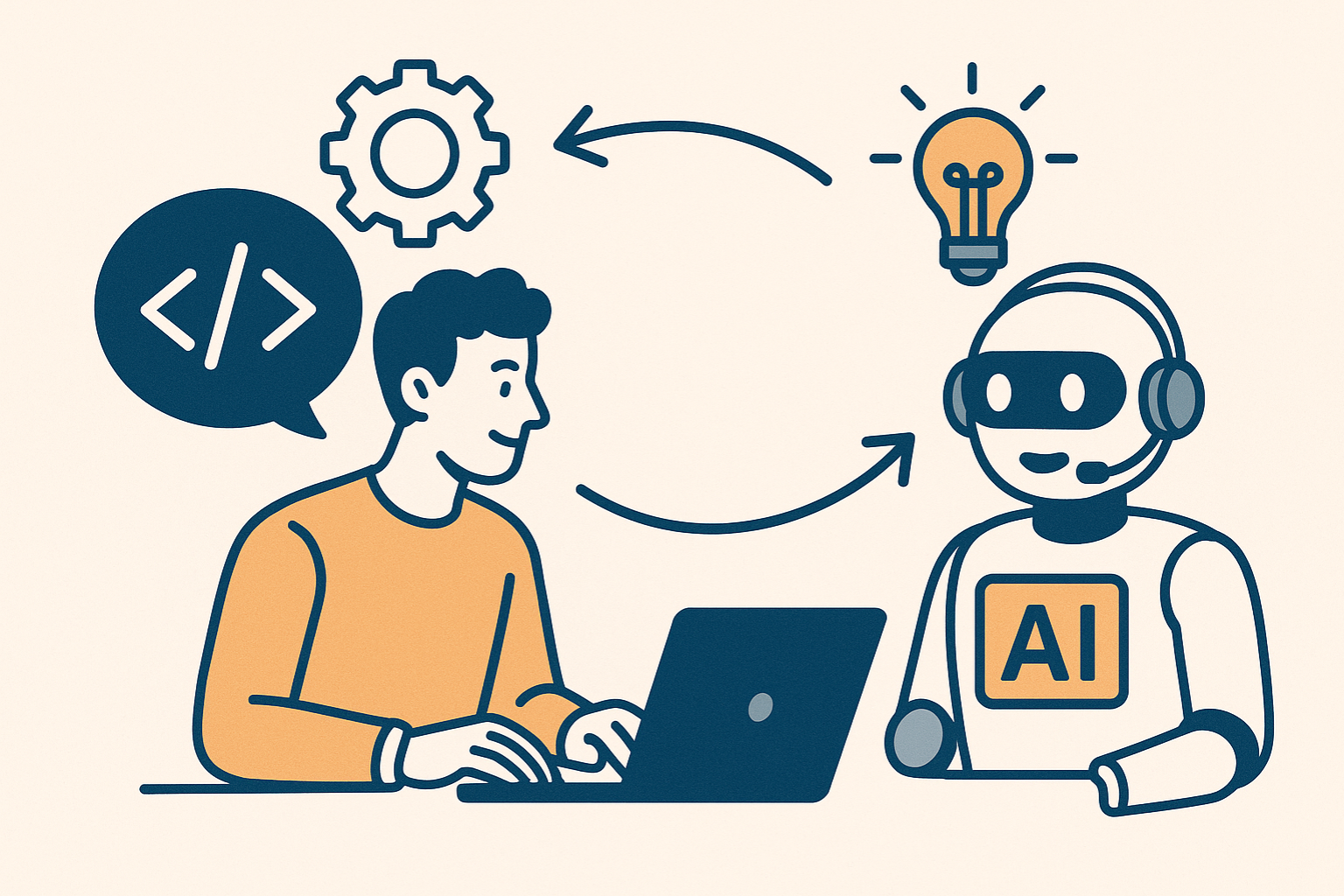
Diagram illustrating the collaboration between a developer and an artificial intelligence system as co-pilot.

The Concept of AI as a Co-pilot: Augmenting, Not Replacing

To understand the depth of AI as co-pilot, It is necessary to go beyond the superficiality of the term. The central role of this system is not to replace the human executor, but rather increase its effectiveness.

Unlike a traditional virtual assistant that simply responds to predefined commands or a robot that operates completely autonomously, the copilot of AI It functions as a collaborative partner, inserting itself into the workflow to anticipate needs, suggest complex solutions, and execute draft tasks.

It is a context-based support tool, capable of learning from the user's work style to refine its suggestions.

The core of the technology lies in sophisticated application of LLMs, which allow interaction in natural language, transforming textual commands into practical results, such as writing a code function, generating a data report, or creating an interface layout.

Co-pilot vs. Assistant and Autonomous Agent: Cognitive Collaboration

It is essential to distinguish between the AI copilot and other forms of advanced virtual assistant or the independent agent.

The assistant (like a service chatbot) is reactive and limited to a pre-established scope.

Already the Autonomous AI Agent, a technology that No Code Start Up explores in its business solutions, has the ability to make complex decisions and execute long chains of tasks without human intervention, often with a defined end goal (for example, managing a marketing campaign from start to finish).

The co-pilot, in turn, is in the middle: he is proactive and highly capable, but operates under the Mandatory human supervision and curation.

It acts as a cognitive accelerator. For example, in the development of software, the AI as co-pilot It suggests the next block of code, but it is the developer who reviews, tests, and integrates this suggestion, maintaining responsibility and creative control over the final product.

That is the essence of collaborative assistancea virtuous cycle where the machine provides the smart draft and the human applies the critical judgment and the strategic vision.

The Technological Foundation: The Role of LLMs in Assistance

The Technological Foundation: The Role of LLMs in Assistance

The ability of AI copilot Its usefulness and contextualization stem directly from the architecture of LLMs, the backbones of Generative AI (IAG).

These models (referenced in sources such as OpenAI and IBMThey are trained on vast datasets to identify patterns and predict the most logical sequence of information.

In the context of a co-pilot, the LLM receives the current work context (the code being written, the document being drafted, or the No-Code flow being assembled) and then generates an output that perfectly fits that context.

In the case of GitHub Copilot (one of the first and most well-known tools), this means understanding the name of the function being declared and automatically suggesting the complete internal logic, saving the programmer a significant amount of time.

This power of Generative AI is rapidly migrating to Low-Code platforms, creating a new type of developer, the No-Code Prompts Engineer.

Accelerating Creation: Use Cases of AI as a Co-pilot in the Low-Code/No-Code Ecosystem

Where is AI as co-pilot Its disruptive potential is truly demonstrated in its application to simplified development.

Low-code and no-code platforms have already democratized the creation of software by removing the need for complex code. The addition of a co-pilot of AI It acts like a turbocharger, transforming the learning curve and delivery speed.

The No Code Start Up audience, comprised of entrepreneurs and hybrid developers, is the primary beneficiary of this convergence.

From Ideation to Rapid Prototyping (MVP)

The initial phase of any project — ideation and the creation of the Minimum Viable Product (MVP) — is typically the bottleneck. AI copilot This can drastically mitigate that problem.

Integrated tools can accept a high-level description of an application (“I need a task management app for remote teams with a productivity chart dashboard”) and, in seconds, generate the User interface (UI) draft, The database structure and even the automation flows basics.

This moves the development cycle from the "building" phase to the "refinement" phase immediately.

The user focuses their effort on user experience (UX) design and complex business logic, leaving infrastructure and repetitive tasks to the assistant. AI.

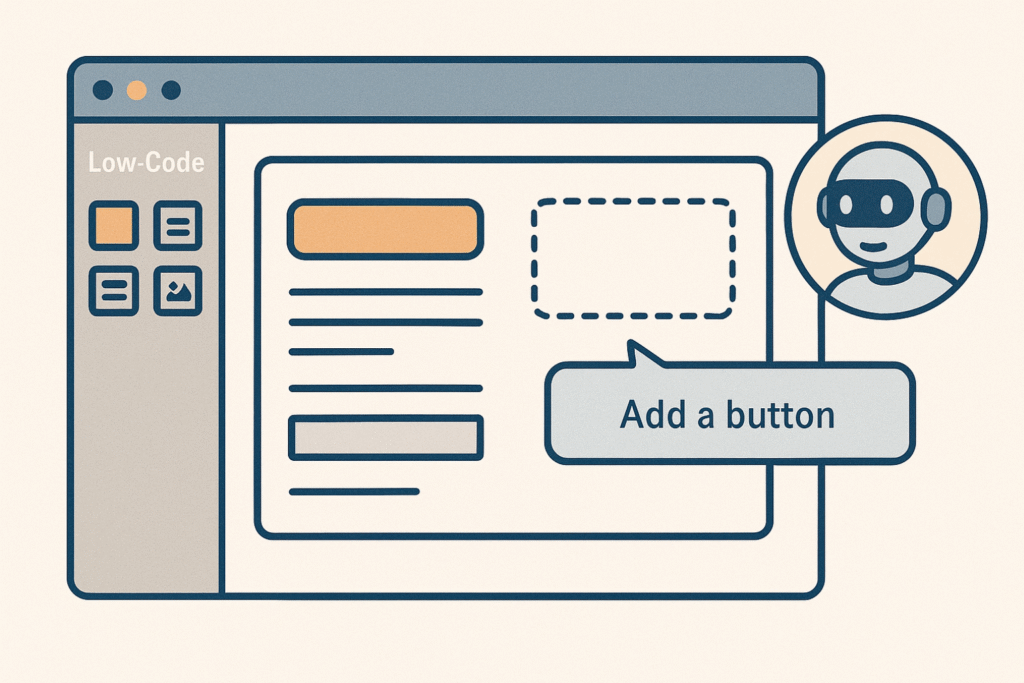
A low-code platform interface with an AI assistant suggesting the next action or component.

Workflow Optimization and Automation of Repetitive Tasks

One of the biggest productivity gains comes from eliminating monotonous tasks. In a low-code context, this means automatically generating integrations (APIs), the templates email, form validation rules, or project technical documentation.

O AI as co-pilot For example, it can analyze an application's data flow and suggest, based on best practices, the optimization of a complex database query or the creation of a... endpoint more efficient.

To delve deeper into how AI can transform business processes, we recommend the No Code Startup page on [topic]. AI and Automation Agents: No-Code Solution for Businesses.

Additionally, in the area of data analysis, The co-pilot translates complex questions into natural language ("What are the 10 customers who purchased the most in the last quarter, grouped by region?") directly into SQL queries or filters in a No-Code data visualization tool.

To explore this synergy, check out our content on... AI for no-code data analysis.

Assisted Code Generation on Hybrid Platforms (e.g., FlutterFlow)

Many leading No-Code platforms, such as FlutterFlow (used to create native applications), generate code in background.

In these hybrid environments, the AI as co-pilot This becomes crucial. It allows No-Code developers to insert custom code snippets (custom functions) or solve... bugs Complex tasks without needing to be a senior full-stack developer.

THE AI It acts as a translator, transforming the user's intent into functional and secure code.

It is this bridge between the visual interface and the programming logic that elevates the capabilities of the Low-Code developer. This is the foundation of our advanced program, the AI Coding Training: Create Apps with AI and Low-Code.

Navigating the Risks: Ethics, Hallucinations, and the New Global Regulation

The adoption of AI as co-pilot It requires a critical look at the inherent risks, especially those related to legal compliance and technical quality.

High speed and ease of use for the co-pilot cannot mask the need for human curation and the legal responsibility of the end user.

Ignoring these risks is the most serious strategic mistake a leader can make when implementing this technology.

The Challenge of Truthfulness (“Hallucinations”) and User Responsibility

The biggest technical limitation of LLMs is what are called "hallucinations"—responses that are generated in a highly plausible way, but are factually incorrect.

When a AI copilot generates a code snippet, a document summary, or a report. compliance, He may inadvertently introduce errors or biases.

Therefore, the golden rule for the collaborative assistance and: AI output should be treated as a high-quality draft that requires rigorous human validation..

In the development of software, this means that the responsibility for the security, efficiency, and functionality of the final code lies with the developer. always from the developer who accepted the co-pilot's suggestion.

Excessive reliance and a lack of critical review are the main factors that negate productivity gains and introduce vulnerabilities into the system.

Conceptual image of a legal and ethical labyrinth symbolizing the challenges of implementing artificial intelligence.

Intellectual Property, Copyright and the Impact of the EU AI Act

With the proliferation of systems like GitHub Copilot, the issue of Intellectual Property (IP) and... copyright It became central.

The code generated by AI as co-pilot He was trained in a vast corpus open source and proprietary.

The question arises: who owns the final code? Technology companies, such as Microsoft, have begun offering indemnification protections in cases of litigation, but legal risk still exists.

Globally, the European Union is at the forefront with the EU AI Act (European Parliament, 2023), which aims to classify systems of Artificial intelligence based on risk.

Although many co-pilots are considered systems of low risk or limited risk, Those used in critical applications (such as healthcare or infrastructure) may fall into the “high risk” category.EU Artificial Intelligence Act, Article 6), requiring strict requirements of compliance and data transparency.

It is crucial to understand the distinction between a standard copilot and a... Artificial Intelligence System high risk (MinnaLearn, 2025).

The Brazilian Legal Landscape: Bill 2338/2023 and Risk Classification

In Brazil, the regulatory landscape is advancing with the Bill No. 2338/2023 (Federal Senate), which also adopts risk classification.

Business leaders and developers who use the AI as co-pilot Those involved in projects for Brazilian clients should closely monitor this legislation.

Non-compliance with future rules on transparency, model explainability (XAI), and data privacy (in line with the LGPD) may result in significant penalties.

The legal basis for the technology you are developing or using is just as important as the technical basis.

Strategies for Maximizing Productivity with Collaborative Assistance

Strategies for Maximizing Productivity with Collaborative Assistance

To reap the rewards of AI as co-pilot and guarantee a increased productivity In reality, the implementation strategy must be deliberate.

It's not just about installing the tool, but about integrating the workflow. collaborative assistance in team culture. Companies that treat the AI A "ask and copy" approach, however, fails to capture its full value.

Prompt Optimization and Human Curation of AI Output

The new “code” is the prompt. The quality of the output of AI copilot It is directly proportional to the clarity and context provided in the input.

Develop skills of Prompt Engineering This becomes a top priority. This involves:

  1. Role Definition: Start the prompt by asking to AI to assume a specific role (“Act as a senior software architect…”)
  2. Providing Context: Include code examples or documents relevant to the project.
  3. Format Restriction: Specify the desired output format (language, framework, (Low-Code style).

Furthermore, the human curation It's the differentiating factor. A well-trained team not only accepts the co-pilot's suggestions, but refines them, compares them with best market practices, and customizes them to the project's unique architecture.

This ensures that AI as co-pilot It should function as a force multiplier, not as a shortcut to mediocrity.

Strategic Integration with Enterprise Tools (Microsoft 365 Copilot)

THE AI as co-pilot is being embedded in the heart of softwares that we use daily.

Microsoft 365 Copilot, for example, integrates the Generative AI directly into productivity tools (Word, Excel, Teams, Outlook).

This type of collaborative assistance It optimizes daily tasks, such as:

  • Abstracts: Generate executive summaries of long Teams meetings.
  • Drafts: Create drafts of complex emails or documents. compliance.
  • Analysis: Transforming raw Excel data into visualizations and insights actionable.

Companies should consider the architecture of AI infrastructure necessary to support these scale models.

To understand What is AI infrastructure and why is it essential? It is essential to ensure the security and governance of the data that feeds these co-pilots.

The Future of Hybrid Development: Human Dependence in the AI Cycle

The technology of AI as co-pilot It is irreversibly improving the development lifecycle of software.

According to the McKinsey, AI is not replacing jobs, but redefining what it means to be a productive professional.

In the Low-Code and No-Code universe, this means that expertise is no longer in typing lines of code, but in:

  1. Orchestration: Managing the supply chain of AI, from the curation of prompts until the outputs are validated.
  2. Business Vision: Translating customer needs directly into the architecture of AI and Low-Code.
  3. Risk Mitigation: Ensure that all generated code or workflow artifacts are legally and technically compliant.

The Learning Curve and the Evolution of the Developer Profile

The arrival of AI as co-pilot It has established a new learning curve. The developer of the future doesn't need to memorize syntax, but rather master the art of collaborating with the machine.

The ability to AI Coding, which allows you to create apps robust and functional using AI to accelerate the logic and the backend, It is the most valuable skill in the market.

O AI copilot It's the mentor who teaches the junior developer to think like a senior developer, and the senior developer to focus on innovation, relegating repetition to the machine.

Illustration of a Low Code developer in control of a futuristic application creation panel, symbolizing mastery over AI tools.

Frequently Asked Questions (FAQ) about AI as a Co-pilot

1. What is the main difference between an Autonomous AI Agent and an AI Co-pilot?

The fundamental difference lies in the level of autonomy and responsibility. AI Co-pilot It is a system of collaborative assistance which requires human intervention to review, validate, and finalize your suggestions.

The Autonomous AI Agent, on the other hand, is designed to make decisions and execute complex task chains without continuous supervision, aiming for a high-level objective. In the Agent, the machine has greater decision-making power; in the Copilot, the human maintains control.

2. Does AI as a co-pilot pose a risk to code security?

It could pose a risk if the human curation for neglected. One AI copilot, Based on LLMs, it can generate code that, while functional, contains security vulnerabilities (e.g., flaws in data input validation) or bugs technical (“hallucinations”).

The ultimate responsibility for security auditing and code stability lies with the user. That's why training in... AI Coding emphasizes best practices and critical validation of the output of AI.

3. Does the use of AI copilots create copyright or intellectual property issues?

Yes, this is a rapidly evolving area of legal risk. The code generated by tools like GitHub Copilot is based on training data that may include proprietary code or code under restricted open-source licenses.

Although companies AI Even though they offer indemnification protections, the risk of litigation exists.

It is recommended that companies establish clear policies regarding the use of code generated by AI as co-pilot, especially in critical projects, and that they review the licenses of their softwares assisted.

4. How can I start using AI as a co-pilot in No-Code development?

The most effective starting point is through experimentation on platforms that have already integrated assistants. Generative AI.

Search for AI Coding Training which teaches how to use the AI to generate the logic and structure of apps in Low-Code environments, allowing you to accelerate MVP prototyping and the building of complex features without getting bogged down in manual code.

The focus should be on learning how to formulate. prompts accurate and validating the output.

What is clear is that the future of software development, especially in the Low-Code and No-Code ecosystem, is irrevocably linked to... AI as co-pilot.

This collaborative assistance It is the engine for the increased productivity that startups and modern companies demand.

THE Generative AI It is democratizing the ability to create, allowing business visions to materialize into digital products with unprecedented speed.

However, true mastery lies not in blindly adopting the tool, but in its strategic and conscious use.

Success demands a new set of skills: the ability to curate the output of... AI, to master the art of Prompt Engineering and to navigate safely through the complex ethical and regulatory landscape.

The professional who masters this collaboration becomes the architect who decides what to do. AI You must draft the design while maintaining complete control over the quality, safety, and compliance of the final product.

To transform this theoretical understanding into a competitive advantage and begin building robust and secure applications assisted by artificial intelligence, Discover the AI Coding Training now and master the future of Low-Code.

mathues castelo profile

Matheus Castelo

grandson camarano profile

Neto Camarano

Two entrepreneurs who believe technology can change the world

Also visit our Youtube channel

en_USEN
menu arrow

Nocodeflix

menu arrow

Community