
THE Artificial Intelligence as co-pilot It's not just a tool, but a fundamental shift in the work paradigm. It represents a transition from... automation for the increase, enhancing human capabilities to unprecedented levels.
This technology acts as an advanced virtual assistant, utilizing Large-Scale Language Models (LLMs) and... Generative AI (IAG) to provide contextualized support, insights and content generation, whether it's code, design, or text.
The direct impact of this collaboration is felt in the optimization of time and the reduction of technical barriers, making it an indispensable catalyst in the world of... Low-Code and No-Code.
The professional who masters interaction with the AI as co-pilot It becomes an agent of transformation with the potential to execute, in hours, what previously took days or weeks.
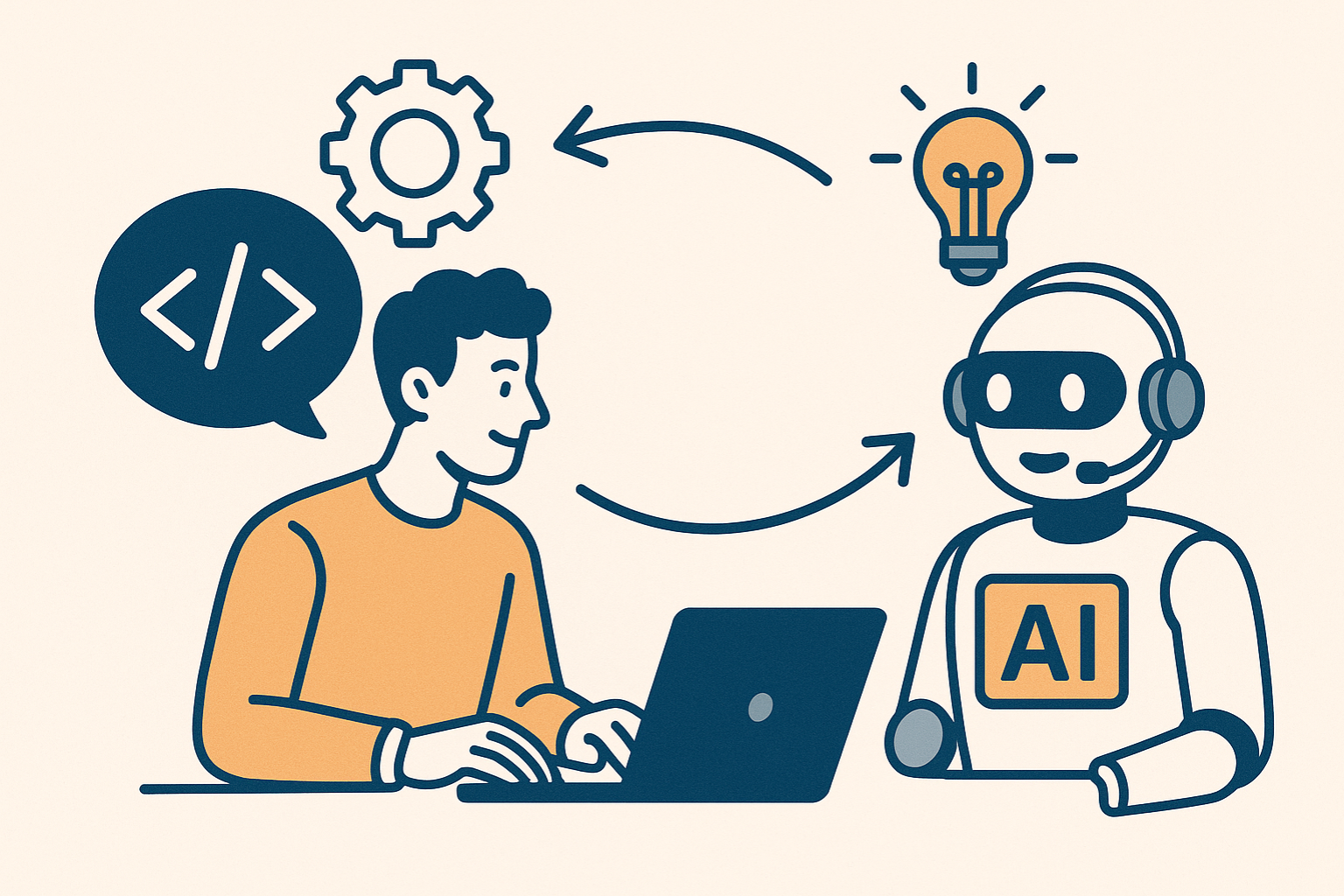
The Concept of AI as a Co-pilot: Augmenting, Not Replacing
To understand the depth of AI as co-pilot, It is necessary to go beyond the superficiality of the term. The central role of this system is not to replace the human executor, but rather increase its effectiveness.
Unlike a traditional virtual assistant that simply responds to predefined commands or a robot that operates completely autonomously, the copilot of AI It functions as a collaborative partner, inserting itself into the workflow to anticipate needs, suggest complex solutions, and execute draft tasks.
It is a context-based support tool, capable of learning from the user's work style to refine its suggestions.
The core of the technology lies in sophisticated application of LLMs, which allow interaction in natural language, transforming textual commands into practical results, such as writing a code function, generating a data report, or creating an interface layout.
Co-pilot vs. Assistant and Autonomous Agent: Cognitive Collaboration
It is essential to distinguish between the AI copilot and other forms of advanced virtual assistant or the independent agent.
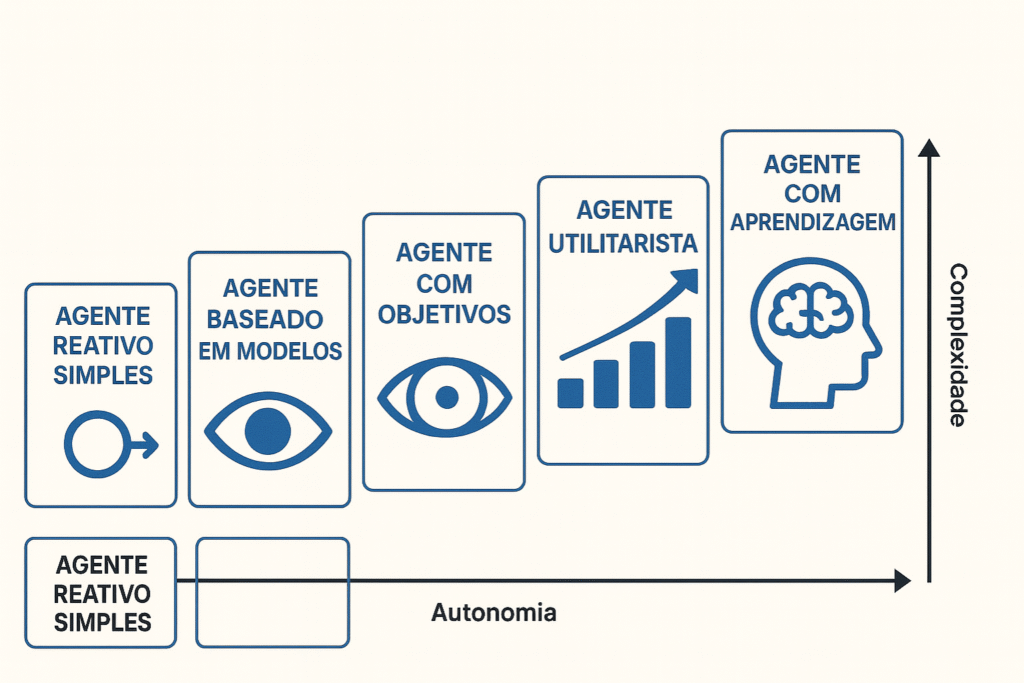
The assistant (like a service chatbot) is reactive and limited to a pre-established scope.
Already the Autonomous AI Agent, a technology that No Code Start Up explores in its business solutions, has the ability to make complex decisions and execute long chains of tasks without human intervention, often with a defined end goal (for example, managing a marketing campaign from start to finish).
The co-pilot, in turn, is in the middle: he is proactive and highly capable, but operates under the Mandatory human supervision and curation.
It acts as a cognitive accelerator. For example, in the development of software, the AI as co-pilot It suggests the next block of code, but it is the developer who reviews, tests, and integrates this suggestion, maintaining responsibility and creative control over the final product.
That is the essence of collaborative assistancea virtuous cycle where the machine provides the smart draft and the human applies the critical judgment and the strategic vision.

The Technological Foundation: The Role of LLMs in Assistance
The ability of AI copilot Its usefulness and contextualization stem directly from the architecture of LLMs, the backbones of Generative AI (IAG).
These models (referenced in sources such as OpenAI and IBMThey are trained on vast datasets to identify patterns and predict the most logical sequence of information.
In the context of a co-pilot, the LLM receives the current work context (the code being written, the document being drafted, or the No-Code flow being assembled) and then generates an output that perfectly fits that context.
In the case of GitHub Copilot (one of the first and most well-known tools), this means understanding the name of the function being declared and automatically suggesting the complete internal logic, saving the programmer a significant amount of time.
This power of Generative AI is rapidly migrating to Low-Code platforms, creating a new type of developer, the No-Code Prompts Engineer.
Accelerating Creation: Use Cases of AI as a Co-pilot in the Low-Code/No-Code Ecosystem
Where is AI as co-pilot Its disruptive potential is truly demonstrated in its application to simplified development.
Low-code and no-code platforms have already democratized the creation of software by removing the need for complex code. The addition of a co-pilot of AI It acts like a turbocharger, transforming the learning curve and delivery speed.
The No Code Start Up audience, comprised of entrepreneurs and hybrid developers, is the primary beneficiary of this convergence.
From Ideation to Rapid Prototyping (MVP)
The initial phase of any project — ideation and the creation of the Minimum Viable Product (MVP) — is typically the bottleneck. AI copilot This can drastically mitigate that problem.
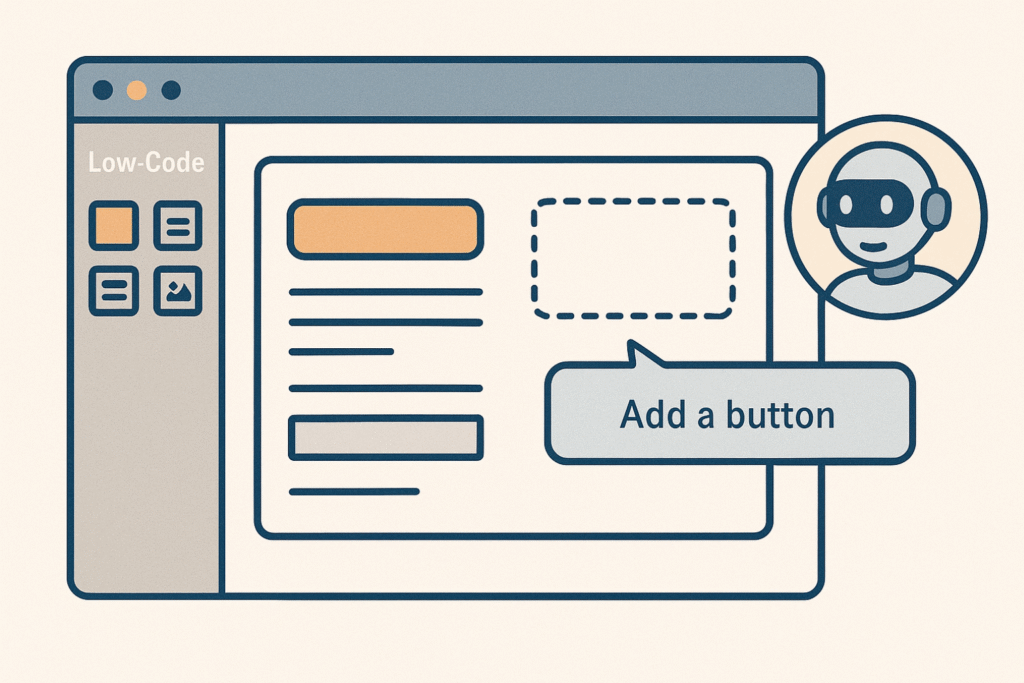
Integrated tools can accept a high-level description of an application (“I need a task management app for remote teams with a productivity chart dashboard”) and, in seconds, generate the User interface (UI) draft, The database structure and even the automation flows basics.
This moves the development cycle from the "building" phase to the "refinement" phase immediately.
The user focuses their effort on user experience (UX) design and complex business logic, leaving infrastructure and repetitive tasks to the assistant. AI.
Workflow Optimization and Automation of Repetitive Tasks
One of the biggest productivity gains comes from eliminating monotonous tasks. In a low-code context, this means automatically generating integrations (APIs), the templates email, form validation rules, or project technical documentation.
O AI as co-pilot For example, it can analyze an application's data flow and suggest, based on best practices, the optimization of a complex database query or the creation of a... endpoint more efficient.
To delve deeper into how AI can transform business processes, we recommend the No Code Startup page on [topic]. AI and Automation Agents: No-Code Solution for Businesses.
Additionally, in the area of data analysis, The co-pilot translates complex questions into natural language ("What are the 10 customers who purchased the most in the last quarter, grouped by region?") directly into SQL queries or filters in a No-Code data visualization tool.
To explore this synergy, check out our content on... AI for no-code data analysis.
Assisted Code Generation on Hybrid Platforms (e.g., FlutterFlow)
Many leading No-Code platforms, such as FlutterFlow (used to create native applications), generate code in background.
In these hybrid environments, the AI as co-pilot This becomes crucial. It allows No-Code developers to insert custom code snippets (custom functions) or solve... bugs Complex tasks without needing to be a senior full-stack developer.
THE AI It acts as a translator, transforming the user's intent into functional and secure code.
It is this bridge between the visual interface and the programming logic that elevates the capabilities of the Low-Code developer. This is the foundation of our advanced program, the AI Coding Training: Create Apps with AI and Low-Code.
Navigating the Risks: Ethics, Hallucinations, and the New Global Regulation
The adoption of AI as co-pilot It requires a critical look at the inherent risks, especially those related to legal compliance and technical quality.
High speed and ease of use for the co-pilot cannot mask the need for human curation and the legal responsibility of the end user.
Ignoring these risks is the most serious strategic mistake a leader can make when implementing this technology.
The Challenge of Truthfulness (“Hallucinations”) and User Responsibility
The biggest technical limitation of LLMs is what are called "hallucinations"—responses that are generated in a highly plausible way, but are factually incorrect.
When a AI copilot generates a code snippet, a document summary, or a report. compliance, He may inadvertently introduce errors or biases.
Therefore, the golden rule for the collaborative assistance and: AI output should be treated as a high-quality draft that requires rigorous human validation..
In the development of software, this means that the responsibility for the security, efficiency, and functionality of the final code lies with the developer. always from the developer who accepted the co-pilot's suggestion.
Excessive reliance and a lack of critical review are the main factors that negate productivity gains and introduce vulnerabilities into the system.
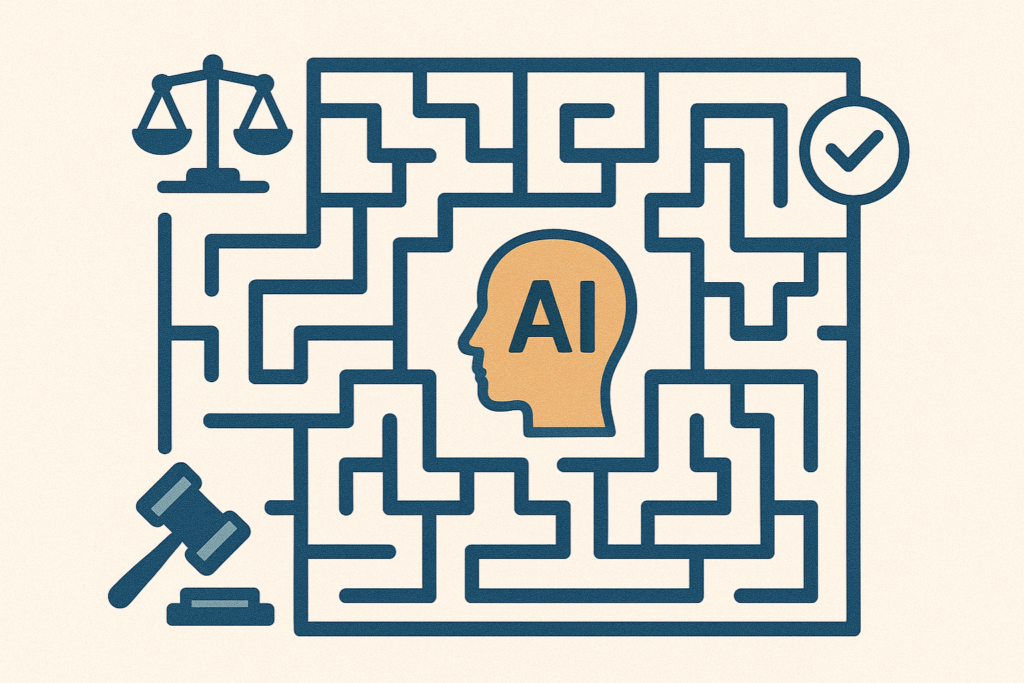
Intellectual Property, Copyright and the Impact of the EU AI Act
With the proliferation of systems like GitHub Copilot, the issue of Intellectual Property (IP) and... copyright It became central.
The code generated by AI as co-pilot He was trained in a vast corpus open source and proprietary.
The question arises: who owns the final code? Technology companies, such as Microsoft, have begun offering indemnification protections in cases of litigation, but legal risk still exists.
Globally, the European Union is at the forefront with the EU AI Act (European Parliament, 2023), which aims to classify systems of Artificial intelligence based on risk.
Although many co-pilots are considered systems of low risk or limited risk, Those used in critical applications (such as healthcare or infrastructure) may fall into the “high risk” category.EU Artificial Intelligence Act, Article 6), requiring strict requirements of compliance and data transparency.
It is crucial to understand the distinction between a standard copilot and a... Artificial Intelligence System high risk (MinnaLearn, 2025).
The Brazilian Legal Landscape: Bill 2338/2023 and Risk Classification
In Brazil, the regulatory landscape is advancing with the Bill No. 2338/2023 (Federal Senate), which also adopts risk classification.
Business leaders and developers who use the AI as co-pilot Those involved in projects for Brazilian clients should closely monitor this legislation.
Non-compliance with future rules on transparency, model explainability (XAI), and data privacy (in line with the LGPD) may result in significant penalties.
The legal basis for the technology you are developing or using is just as important as the technical basis.

Strategies for Maximizing Productivity with Collaborative Assistance
To reap the rewards of AI as co-pilot and guarantee a increased productivity In reality, the implementation strategy must be deliberate.
It's not just about installing the tool, but about integrating the workflow. collaborative assistance in team culture. Companies that treat the AI A "ask and copy" approach, however, fails to capture its full value.
Prompt Optimization and Human Curation of AI Output
The new “code” is the prompt. The quality of the output of AI copilot It is directly proportional to the clarity and context provided in the input.
Develop skills of Prompt Engineering This becomes a top priority. This involves:
- Role Definition: Start the prompt by asking to AI to assume a specific role (“Act as a senior software architect…”)
- Providing Context: Include code examples or documents relevant to the project.
- Format Restriction: Specify the desired output format (language, framework, (Low-Code style).
Furthermore, the human curation It's the differentiating factor. A well-trained team not only accepts the co-pilot's suggestions, but refines them, compares them with best market practices, and customizes them to the project's unique architecture.
This ensures that AI as co-pilot It should function as a force multiplier, not as a shortcut to mediocrity.
Strategic Integration with Enterprise Tools (Microsoft 365 Copilot)
THE AI as co-pilot is being embedded in the heart of softwares that we use daily.
Microsoft 365 Copilot, for example, integrates the Generative AI directly into productivity tools (Word, Excel, Teams, Outlook).
This type of collaborative assistance It optimizes daily tasks, such as:
- Abstracts: Generate executive summaries of long Teams meetings.
- Drafts: Create drafts of complex emails or documents. compliance.
- Analysis: Transforming raw Excel data into visualizations and insights actionable.
Companies should consider the architecture of AI infrastructure necessary to support these scale models.
To understand What is AI infrastructure and why is it essential? It is essential to ensure the security and governance of the data that feeds these co-pilots.
The Future of Hybrid Development: Human Dependence in the AI Cycle
The technology of AI as co-pilot It is irreversibly improving the development lifecycle of software.
According to the McKinsey, AI is not replacing jobs, but redefining what it means to be a productive professional.
In the Low-Code and No-Code universe, this means that expertise is no longer in typing lines of code, but in:
- Orchestration: Managing the supply chain of AI, from the curation of prompts until the outputs are validated.
- Business Vision: Translating customer needs directly into the architecture of AI and Low-Code.
- Risk Mitigation: Ensure that all generated code or workflow artifacts are legally and technically compliant.
The Learning Curve and the Evolution of the Developer Profile
The arrival of AI as co-pilot It has established a new learning curve. The developer of the future doesn't need to memorize syntax, but rather master the art of collaborating with the machine.
The ability to AI Coding, which allows you to create apps robust and functional using AI to accelerate the logic and the backend, It is the most valuable skill in the market.
O AI copilot It's the mentor who teaches the junior developer to think like a senior developer, and the senior developer to focus on innovation, relegating repetition to the machine.

Frequently Asked Questions (FAQ) about AI as a Co-pilot
1. What is the main difference between an Autonomous AI Agent and an AI Co-pilot?
The fundamental difference lies in the level of autonomy and responsibility. AI Co-pilot It is a system of collaborative assistance which requires human intervention to review, validate, and finalize your suggestions.
The Autonomous AI Agent, on the other hand, is designed to make decisions and execute complex task chains without continuous supervision, aiming for a high-level objective. In the Agent, the machine has greater decision-making power; in the Copilot, the human maintains control.
2. Does AI as a co-pilot pose a risk to code security?
It could pose a risk if the human curation for neglected. One AI copilot, Based on LLMs, it can generate code that, while functional, contains security vulnerabilities (e.g., flaws in data input validation) or bugs technical (“hallucinations”).
The ultimate responsibility for security auditing and code stability lies with the user. That's why training in... AI Coding emphasizes best practices and critical validation of the output of AI.
3. Does the use of AI copilots create copyright or intellectual property issues?
Yes, this is a rapidly evolving area of legal risk. The code generated by tools like GitHub Copilot is based on training data that may include proprietary code or code under restricted open-source licenses.
Although companies AI Even though they offer indemnification protections, the risk of litigation exists.
It is recommended that companies establish clear policies regarding the use of code generated by AI as co-pilot, especially in critical projects, and that they review the licenses of their softwares assisted.
4. How can I start using AI as a co-pilot in No-Code development?
The most effective starting point is through experimentation on platforms that have already integrated assistants. Generative AI.
Search for AI Coding Training which teaches how to use the AI to generate the logic and structure of apps in Low-Code environments, allowing you to accelerate MVP prototyping and the building of complex features without getting bogged down in manual code.
The focus should be on learning how to formulate. prompts accurate and validating the output.
What is clear is that the future of software development, especially in the Low-Code and No-Code ecosystem, is irrevocably linked to... AI as co-pilot.
This collaborative assistance It is the engine for the increased productivity that startups and modern companies demand.
THE Generative AI It is democratizing the ability to create, allowing business visions to materialize into digital products with unprecedented speed.
However, true mastery lies not in blindly adopting the tool, but in its strategic and conscious use.
Success demands a new set of skills: the ability to curate the output of... AI, to master the art of Prompt Engineering and to navigate safely through the complex ethical and regulatory landscape.
The professional who masters this collaboration becomes the architect who decides what to do. AI You must draft the design while maintaining complete control over the quality, safety, and compliance of the final product.
To transform this theoretical understanding into a competitive advantage and begin building robust and secure applications assisted by artificial intelligence, Discover the AI Coding Training now and master the future of Low-Code.
















 EN
EN  PT
PT  ES
ES