
Technology is undergoing a historic transition: from passive softwares to autonomous systems. Understanding the types of AI agents It's about discovering tools capable of perceiving, reasoning, and acting independently to achieve complex goals, without the need for micromanagement.
This evolution has transformed the market. For professionals who want to lead the AI infrastructure, Mastering the taxonomy of these agents is no longer optional.
It's the exact competitive differentiator between launching a basic chatbot or orchestrating a complete digital workforce.
In this definitive guide, we'll dissect the anatomy of agents, exploring everything from classic classifications to modern LLM-based architectures that are revolutionizing the No-Code and High-Code worlds.

What exactly defines an AI agent?
Before we explore the types, it's crucial to draw a clear line in the sand. An artificial intelligence agent is not merely a language model or a machine learning algorithm.
The most rigorous definition, accepted both in academia and industry, as in the course Stanford CS221, describes an agent as a computational entity situated in an environment, capable of perceiving it through sensors and acting upon it through actuators to maximize its chances of success.
The Crucial Difference: AI Model vs. AI Agent
Many beginners confuse the engine with the car.
- AI model (ex: GPT-4, Llama 3): It's the passive brain. If you don't send a prompt, it does nothing. It has knowledge, but no agency.
- AI Agent: It's the complete system. It has the model as its core reasoning tool, but it also has memory, access to tools (databases, APIs, browsers), and, crucially, a goal.
An agent uses the model's predictions to make sequential decisions, manage states, and correct the course of its actions.
It's the difference between asking ChatGPT "how to send an email" (Template) and having a software that autonomously writes, schedules, and sends the email to your contact list (Agent).
The 5 Classic Types of AI Agents
To build robust solutions, we need to revisit the theoretical foundation established by Stuart Russell and Peter Norvig, the fathers of modern AI.
The complexity of an agent is determined by its ability to handle uncertainties and maintain internal states.
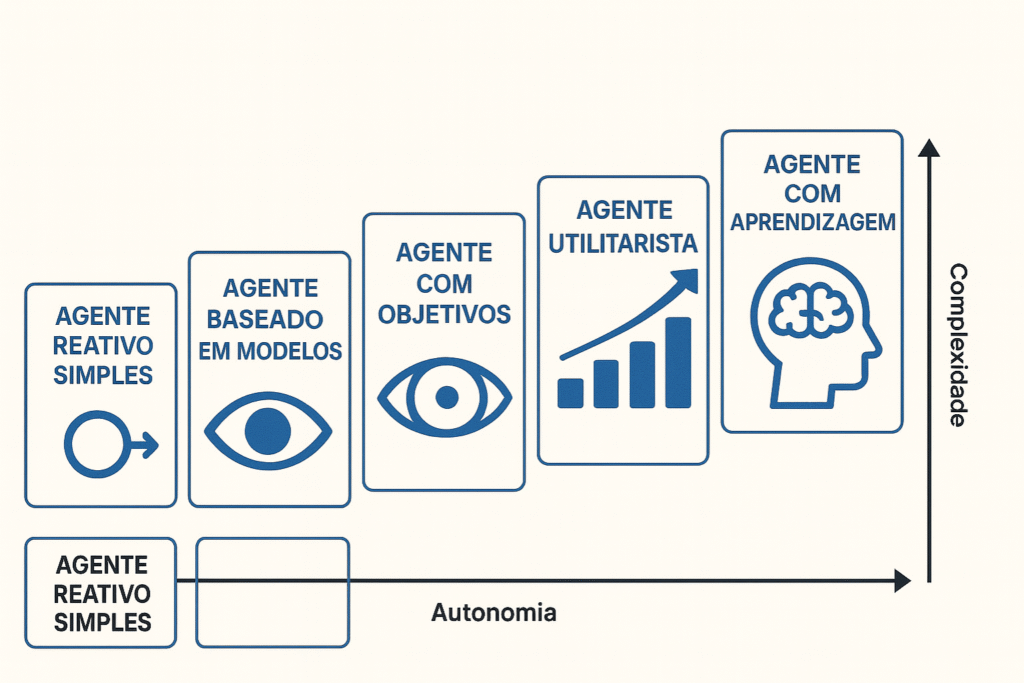
Here are the 5 types of AI agents hierarchical structures that form the basis of any intelligent automation:
1. Simple Reactive Agents
This is the most basic level of intelligence. Simple reactive agents operate on the "if-then" principle.
They only respond to the current input, completely ignoring history or past states.
- How it works: If the sensor detects "X", the actuator does "Y".
- Example: A smart thermostat or a basic spam filter. If the temperature exceeds 25ºC, it turns on the air conditioning.
- Limitation: They fail in complex environments where the decision depends on a historical context.
2. Model-Based Reactive Agents
Taking it a step further, these agents maintain an internal state — a kind of short-term memory.
They don't just look at the "now," but consider how the world evolves independently of their actions.
This is vital for tasks where the environment is not fully observable. For example, in a self-driving car, the agent needs to remember that there was a pedestrian on the sidewalk 2 seconds ago, even if a truck momentarily blocked its view.
3. Goal-Based Agents
True intelligence begins here. Goal-oriented agents don't just react; they plan.
They have a clear description of a "desirable" state (the goal) and evaluate different sequences of actions to achieve it.
This introduces search and planning capabilities. If the goal is to "optimize the database," the agent can simulate various paths before executing the final command, something essential for those working with... AI for data analysis.
4. Utility-Based Agents
Often, achieving the goal is not enough; it is necessary to achieve it in the best possible way. Utility-based agents use a utility function (score) to measure preference between different states.
If a logistics agent aims to deliver a package, the utility agent will calculate not only the route that gets there, but the fastest route, using the least amount of fuel and with the greatest safety. It's about maximizing efficiency.
5. Agents with Learning
At the top of the classic hierarchy are the agents capable of evolving. They have a learning component that analyzes feedback from their past actions to improve their future performance.
They start with basic knowledge and, through exploration of the environment, adjust their own decision rules. This is the principle behind advanced recommendation systems and adaptive robotics.
What are generative agents based on LLMs?
Classical taxonomy has evolved. With the arrival of the Big Language Models (LLMs), a new category has emerged that dominates current discussions: Generative Agents.
In these systems, the LLM acts as the central controller or "brain," using its vast knowledge base to reason about problems that were not explicitly programmed, as detailed in the seminal paper on... Generative Agents.
Reasoning Frameworks: ReAct and CoT
For an LLM to function as an effective agent, we utilize techniques of prompt engineering advanced principles that structure the model's thinking:
- Chain-of-Thought (CoT): The agent is instructed to break down complex problems into intermediate steps of logical reasoning ("Let's think step by step"). Research indicates that this technique... It stimulates complex reasoning. in large models.
- ReAct (Reason + Act): This is the most popular architecture currently. The agent generates a thought (Reason), executes an action on an external tool (Act), and observes the result (Observation). This loop, described in the paper... ReAct: Synergizing Reasoning and Acting, This allows it to interact with APIs, read documentation, or execute Python code in real time.
Tools like AutoGPT and BabyAGI They popularized the concept of autonomous agents that create their own task lists based on these frameworks.
You can explore the original code of AutoGPT on GitHub or from BabyAGI to understand the implementation.
Tip in Specialist: For those who wish to delve deeper into the technical design of these systems, our AI Coding Training It explores exactly how to orchestrate these frameworks to create intelligent softwares.
Architectures: Single Agent vs. Multi-Agent Systems
When developing a solution for your company, you will face a critical architectural choice: should you use a super agent that does everything or multiple specialists?
What is the difference between Single Agent and Multi-Agent Systems?
The difference lies in form of organization of intelligence.
One Single Agent It concentrates all the logic and execution into a single entity, making it simpler, faster, and easier to maintain, ideal for straightforward tasks with a well-defined scope.
Already the Multi-Agent Systems They distribute the work among specialized agents, each responsible for a specific function.
This approach increases the ability to solve complex problems, improves the quality of results, and facilitates the scalability of the solution.
When should you use a Single Agent?
A single agent is ideal for linear, narrow-scope tasks. If the goal is "summarize this PDF and send it by email," a single agent with the right tools is efficient and easy to maintain.
Latency is lower and development complexity is reduced.
The Power of Multi-Agent Orchestration
For complex problems, the industry is migrating to Multi-Agent Systems (MAS). Imagine a digital agency: you don't want the copywriter to do the design and approve the budget.
Recent technical discussions, such as this one Single vs Multi-Agent debate, They show that specialization trumps generalization.
In a multi-agent architecture, you create:
- A "Researcher" agent that searches for data on the web.
- An "Analyst" agent that processes the data.
- An agent called "Writer" who creates the final report.
- A "Critical" agent who reviews the work before delivery.
This specialization mimics human organizational structures and tends to produce higher quality results.
Modern frameworks facilitate this orchestration, such as LangGraph for complex flow control, the CrewAI for teams of role-based agents, and even lighter libraries such as Hugging Face smolagents.

Practical Applications and No-Code Tools
The theory is fascinating, but how does this translate into real value? Different types of AI agents are already operating behind the scenes of large, agile startups operations.
Coding and Development Agents
Autonomous agents such as Devin or open-source implementations such as OpenDevin They utilize planning architectures and tools to write, debug, and deploy entire codebases.
In the No-Code environment, tools such as FlutterFlow and Bubble They are integrating agents that assist in building complex interfaces and logic using only text commands.
Data Analytics Agents
Instead of relying on analysts to generate manual SQL reports, utility- and goal-oriented agents can connect to your data warehouse, formulate queries, analyze trends, and generate proactive insights.
This democratizes access to high-level data.
Solutions for Businesses
For the corporate sector, the implementation of AI-powered automation solutions It focuses on operational efficiency.
Customer service agents (Customer ExperienceAgents who not only answer questions but also access the CRM to process reimbursements or change plans are examples of goal-oriented agents that generate immediate ROI.
Companies like Zapier and the Salesforce They already offer dedicated platforms for creating these corporate assistants.

Frequently Asked Questions about AI Agents
Here are the most common questions we receive from the community, which dominate searches on Google and in forums like... Reddit:
What is the difference between a chatbot and an AI agent?
A traditional chatbot typically follows a rigid script or simply responds based on trained text.
An AI agent has autonomy: it can use tools (such as a calculator, calendar, email) to perform real-world tasks, not just converse.
What are autonomous agents?
These are systems that can operate without constant human intervention. You define a broad objective (e.g., "Discover the 5 best SEO tools and create a comparison table"), and the autonomous agent decides which websites to visit, what data to extract, and how to format the results on its own.
Do I need to know how to program to create an AI Agent?
Not necessarily. While knowledge of logic is vital, modern platforms and No-Code frameworks allow the creation of powerful agents through visual interfaces and natural language.
For advanced customizations, however, understanding the logic of AI Coding That's a huge advantage.
The Future is Agentic — And It Requires Architects, Not Just Users
Understanding the types of agents AI It's the first step in moving from being a consumer of technology to being a creator of solutions.
Whether it's a simple reactive agent for email triage or a complex multi-agent system for managing e-commerce operations, digital autonomy is the new frontier of productivity.
The market is no longer just looking for those who know how to use ChatGPT, but those who know... designing workflows that ChatGPT (and other models) will execute.
If you want to move beyond theory and master building these tools, the ideal next step is to learn about our... AI Agent Manager Training. The era of agents has only just begun — and you could be in charge of it.










 EN
EN  PT
PT  ES
ES