
One AI agent for no-code ETL It is a solution that automates data extraction, transformation and loading (ETL) processes using artificial intelligence integrated into no-code platforms.
This means that professionals without programming experience can build and operate data pipelines with intelligent AI support, saving time and money and reducing reliance on technical teams.
The central idea is to democratize access to data engineering and enable startups, freelancers, marketing teams, and business analysts to make autonomous, data-driven decisions, all powered by no-code ETL with artificial intelligence.
This approach has been particularly powerful when combined with tools such as n8n, Make (Integromat) and Dify, which already offer integrations with generative AI and visual ETL operations.
Check out our n8n course and master ETL with AI.
Why use AI agents in the ETL process?

Integrate artificial intelligence agents The no-code ETL workflow brings practical and strategic benefits, promoting data automation with generative AI.
The first is AI's ability to interpret data based on context, helping to identify inconsistencies, suggest transformations, and learn patterns over time.
With this, we not only eliminate manual steps such as data cleansing and table restructuring, but we also allow tasks to be executed at scale with precision.
Automation platforms such as make up and n8n already allow integrations with OpenAI, enabling the creation of intelligent automations for data, as:
- Anomaly detection via prompt
- Semantic classification of entries
- Generation of interpretive reports
- Automatic conversion of unstructured data into organized tables.
All of this, with visual flows and based on rules defined by the user.
How do AI agents for no-code ETL work?
In practice, a AI agent for no-code ETL It acts as a virtual operator that performs tasks autonomously based on prompts, rules, and predefined objectives.
These agents are built on no-code platforms that support calls to AI model APIs (such as OpenAI, Anthropic, or Cohere).
Executing an ETL flow with AI involves three main phases:
Extraction
The agent connects to data sources such as CRMs, spreadsheets, databases, or APIs and collects data according to defined triggers.
Transformation
With AI, data is processed automatically: named columns, grouped data, summarized text, categorized fields, inferred missing data, among others.
Loading
Finally, the transformed data is sent to destinations such as dashboards, internal systems, or cloud storage like Google Sheets or PostgreSQL.
To orchestrate data pipelines at scale, Managed services like Google Cloud Dataflow can be integrated into the flow.
Learn how to integrate AI with automations using our OpenAI agent course.
Popular tools for creating AI agents for ETL.
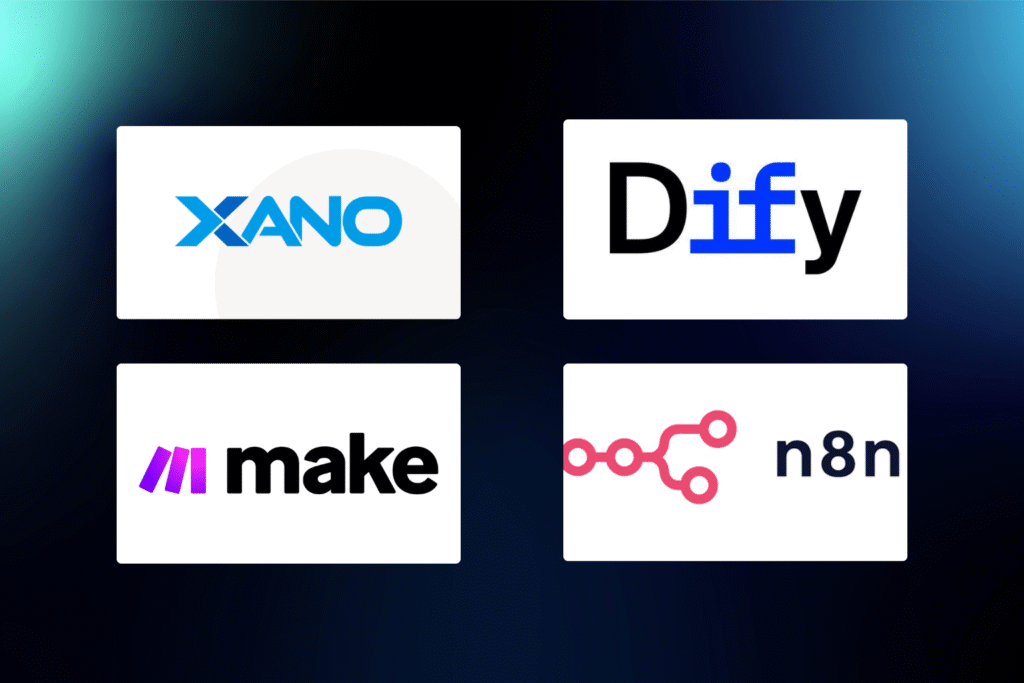
Today, a series of no-code tools for ETL pipelines This allows the creation of agents focused on data operations. The most relevant include:
n8n with OpenAI
n8n allows you to create complex flows with smart us Using generative AI. Ideal for workflows with conditional logic and handling large volumes of data.
Make (Integromat)
With a more user-friendly interface, Make is ideal for those who want speed and simplicity. It allows integration with AI models to process data automatically.
Dify
One of the most promising platforms for creating autonomous AI agents with multiple functions. It can be integrated with data sources and transformation scripts.
Check out our complete Dify course and master creating AI agents.
Xano
Although primarily focused on no-code backend development, Xano enables AI-powered workflows and can be used as an endpoint for processed data.
Real-world use cases and concrete applications

Companies and independent professionals are already using AI agents for code-free ETL in various contexts, boosting their operations and reducing manual bottlenecks.
Startups SaaS
Startups that develop digital products, especially SaaS, use AI agents to accelerate user onboarding and personalize their experiences from the very first access.
By integrating registration forms with databases and analytics tools, these agents extract key information, categorize profiles, and deliver valuable insights about user behavior to the product team.
This allows for more assertive actions in UX, retention, and even the development of features based on real-time, up-to-date data.
Marketing teams
Marketing departments are finding in AI agents for ETL a powerful solution to deal with data fragmentation across multiple channels.
By automating the collection of campaign information from Google Ads, Meta Ads, CRMs, and email tools, it's possible to centralize everything into a single, intelligent workflow.
AI also helps to standardize terminology, correct inconsistencies, and generate analyses that optimize real-time decision-making, improving budget allocation and campaign ROI.
Financial analysts
Analysts and finance teams leverage these agents to eliminate manual and repetitive steps in document processing.
For example, an agent can read bank statements in PDF format, convert the data into organized spreadsheets, apply sorting logic, and even generate automatic charts for presentation.
This shifts the analyst's focus from data entry to strategic interpretation, resulting in faster reports with less margin for error.
Agencies and freelancers
Freelancers and B2B agencies offering digital solutions are using AI agents to deliver more value with less operational effort.
For example, by building a smart ETL pipeline, a freelancer can integrate the client's website with a CRM, automatically categorize incoming leads, and trigger weekly reports.
This allows you to scale your service, generate measurable results, and justify ticket price increases based on AI-optimized deliveries.
Discover how to apply context engineering to boost your automations.
Trends for the future of AI-powered ETL agents

The use of AI agents for code-free ETL It tends to expand with the advancement of language models and more robust integrations.
Next, we explore some of the key trends that promise to further transform this scenario:
Agents with long contextual memory
With extended memory, agents can retain the context of previous interactions, enabling greater accuracy in history-based decisions and more refined personalization in automated data flows.
Integrations with LLMs specializing in tabular data
Language models trained specifically to handle tabular structures — such as TabTransformer — They make the transformation and analysis process much more efficient, allowing for deeper interpretations and smarter automation.
Conversational interfaces for creating and operating pipelines.
Creating ETL pipelines can become even more accessible with natural language-based interfaces, where the user interacts with an agent through written or spoken questions and commands, without the need for visual logic or coding.
Predictive automation based on operational history.
By analyzing historical pipeline execution patterns, agents can anticipate needs, optimize recurring tasks, and even autonomously suggest improvements to the data flow.
You can get started today with AI agents for no-code ETL.

If you want to learn how to apply AI agents for no-code ETL in your project, startup, or company, you no longer need to rely on developers.
With accessible tools and practical training, it's possible to create intelligent, scalable, and resource-saving ETL workflows without programming.
Explore our Agent and Automation Manager Training with AI and begin to master one of the most valuable skills of the new era of artificial intelligence applied to data.

















 EN
EN  PT
PT  ES
ES