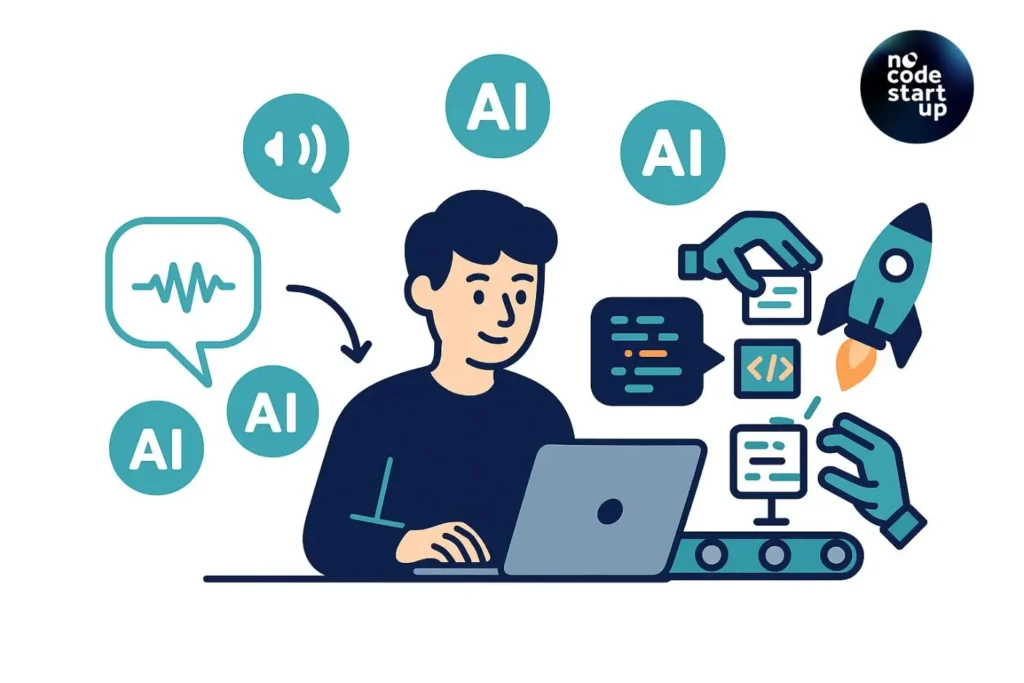
First of all: the movement to create apps "only with AI" has grown significantly. Cases like Lovable and Cursor made headlines with massive funding rounds, and this changed the conversation in the market. Whether we like it or not, it's a trend—either we learn to extract value, or we get left behind.
Contents
Origin of the term and market context

the term Vibe Code (VibeCode) It stems from a tweet by Andrej Karpathy: the idea of "surrendering to the vibes" and building guided by AI. It's a fun concept, but I insist: software requires... responsibility Technical and product-related aspects. It's not just "asking AI"; there's architecture, front-end, back-end, and security involved.

In the current scenario, Vibe Code tools They are multiplying and attracting heavy investment. This shows a real demand for speed and accessibility in the construction of software. My point is to balance enthusiasm with rigor: use AI, yes; but with discretion.
Main tools (Loveable, Cursor, etc.)

The ecosystem has Lovable, Cursor, Replit, Bolt, Base44, IdSurf, among others. Each one focuses on different experiences, but they share the core: You describe it, and the AI builds it.. If you'd like, I can provide a detailed comparison in another article—new information has been emerging almost every week.
The practical point is to choose by task and by internship For a simple page, landing page, or clickable prototype, an AI-powered IDE that generates and edits code may suffice. For larger platforms, you should already be thinking about maintenance, versioning, and debugging.
Differences between Vibe Code, No-Code, and traditional modes.
Node No-Code (ex.: Bubble, FlutterFlow, WebWebIn this system, you build by dragging and dropping visual blocks. It's great for granular interface and data control without writing code. Vibe Code, you prompt, You describe what you want, and the AI generates the design or code.
O traditional code It offers complete technical freedom, but it costs time and expertise. What's happening now is a convergence: No-Code incorporating generative AI. Result: prompt + visual editing = more speed. and More control.
Advantages of Vibe Code

The first advantage is... absurd speedIt's possible to bring websites, landing pages, and MVPs to life in hours. This is invaluable for validating value propositions, testing the market, and iterating with real feedback. AI accelerates the "0 → 1" process in a way that was previously unthinkable.
The second one is Accessibility for non-devsEntrepreneurs and business teams are able to prototype. Fewer barriers to entry mean more people experimenting with solutions. And that frees up developers for truly complex challenges.
It also shines in low complexityMicrosites, apps with few screens and simple rules. When the business rule is lightweight, the AI is more accurate and you save time. lower initial cost It helps to test traction before investing heavily.
Difficulties (the "B side")
There is finer controlYou request A, and the AI sometimes modifies B. Editing "just a small part" can affect other generated components. Speed increases, but predictability doesn't always keep pace.
Fundamentals matter.Architecture, data, backend, and security. Without a solid foundation, you can create something beautiful but fragile on the inside. I recommend studying the minimum viable product before scaling.
In complex projects Caution is needed because the stack is still new. Validate simply, prove value, and only then move on to more stringent rules. Skipping steps usually leads to expensive rework.
Points to consider (quick checklist)
1) Define a simple scope first. Start with a lean MVP, gather feedback, and iterate. Complexity comes in after the basics are validated.
2) Standardize prompts and history. Save versions of what you requested and what the AI generated. This makes re-generation, auditing, and debugging easier.
3) Treat the generated code as a starting point. Review, module, and write minimal tests. Where it hurts, bring it back. No-Code/Low-Code or traditional development.
4) Security from day one. Take care of sensitive data, authentication, permissions, and logs. "Pretty" doesn't replace "secure.".
5) Plan maintenance. Define who versions, who audits, and how to publish without breaking the process. The tool changes; the process needs to be solid.
What can be built (and when)?
Sites and landing pages They're perfect for Vibe Code: speed with good visual quality. Lightweight apps and MVPs They work very well for testing hypotheses and demonstrating value. SaaS complete It's possible, but proceed in stages and with technical governance.
Closing the idea

Vibe Code is a accelerator, This is not a substitute for the discipline of software. Use AI to get to a "breathing product" faster, with safety and clarity. Technical responsibility + short iterations greatly increase the chance of success.
If you agree, disagree, or have already built something complex with Vibe Code, tell me about it. I want to hear about your experiences to create future content. Thanks — and until next time!















 EN
EN  PT
PT  ES
ES