


Context engineering has become a central discipline for the advancement of artificial intelligence, especially when we talk about autonomous agents, Retrieval-Augmented Generation (RAG) systems, and enterprise AI applications.
In this article, we will explore what context engineering is, how to apply it strategically, which tools and methodologies are trending, and why it is so essential in creating intelligent agents that generate real value.
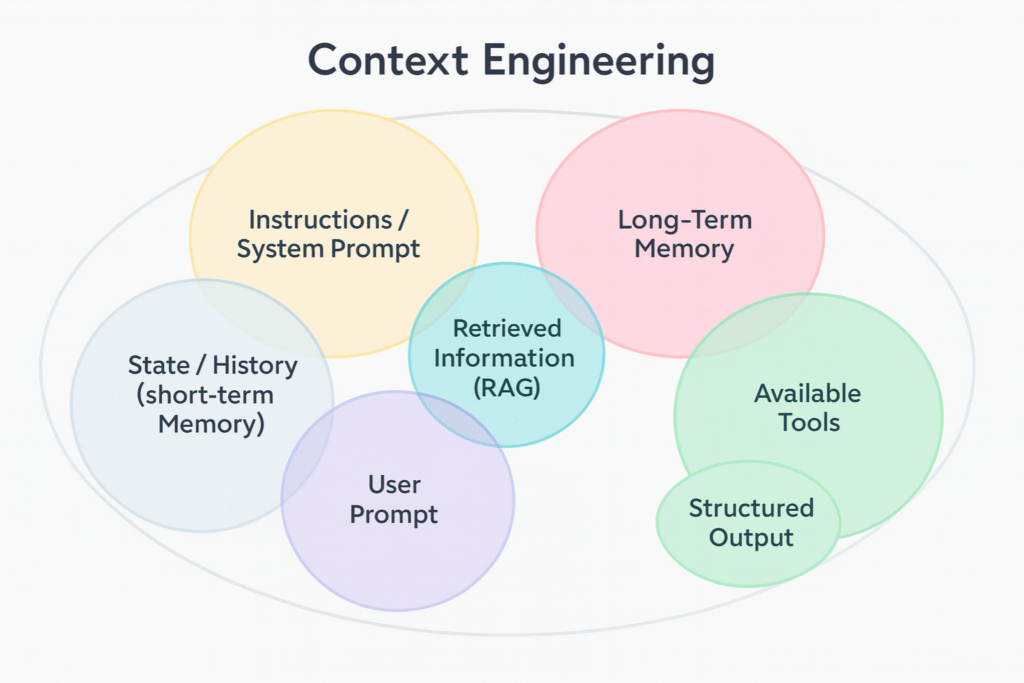
What is Context Engineering?
THE context engineering It is the practice of structuring, organizing, and providing relevant contextual information to artificial intelligence systems with the goal of increasing the accuracy, coherence, and efficiency of the generated responses.
Unlike prompt engineering, which focuses on how to write instructions, context engineering is concerned with... what is behind the instructionThe data, metadata, contextual memory, and runtime environment architecture.
In a modern AI agent, context is fundamental to ensuring consistency between interactions.
For example, a customer service chatbot cannot repeat information or contradict itself during a conversation. This requires a robust and well-structured contextual foundation.
Context Engineering in Practice: How it Works
In practice, context engineering functions as a data and memory orchestrator. Instead of feeding a language model with generic prompts, we insert enriched instructions with:
- Relevant past memories
- Data retrieved dynamically via RAG.
- Structured data (spreadsheets, databases)
- Meta information about the user or the problem.
Imagine an AI agent responsible for generating business proposals. If it receives only the phrase "create a proposal for client X," it will likely produce a generic text.
Now, if we use context engineering and provide data about the client, contracted services, negotiation history, success stories, and quarterly goals, the same prompt can generate an incredibly personalized and effective document.
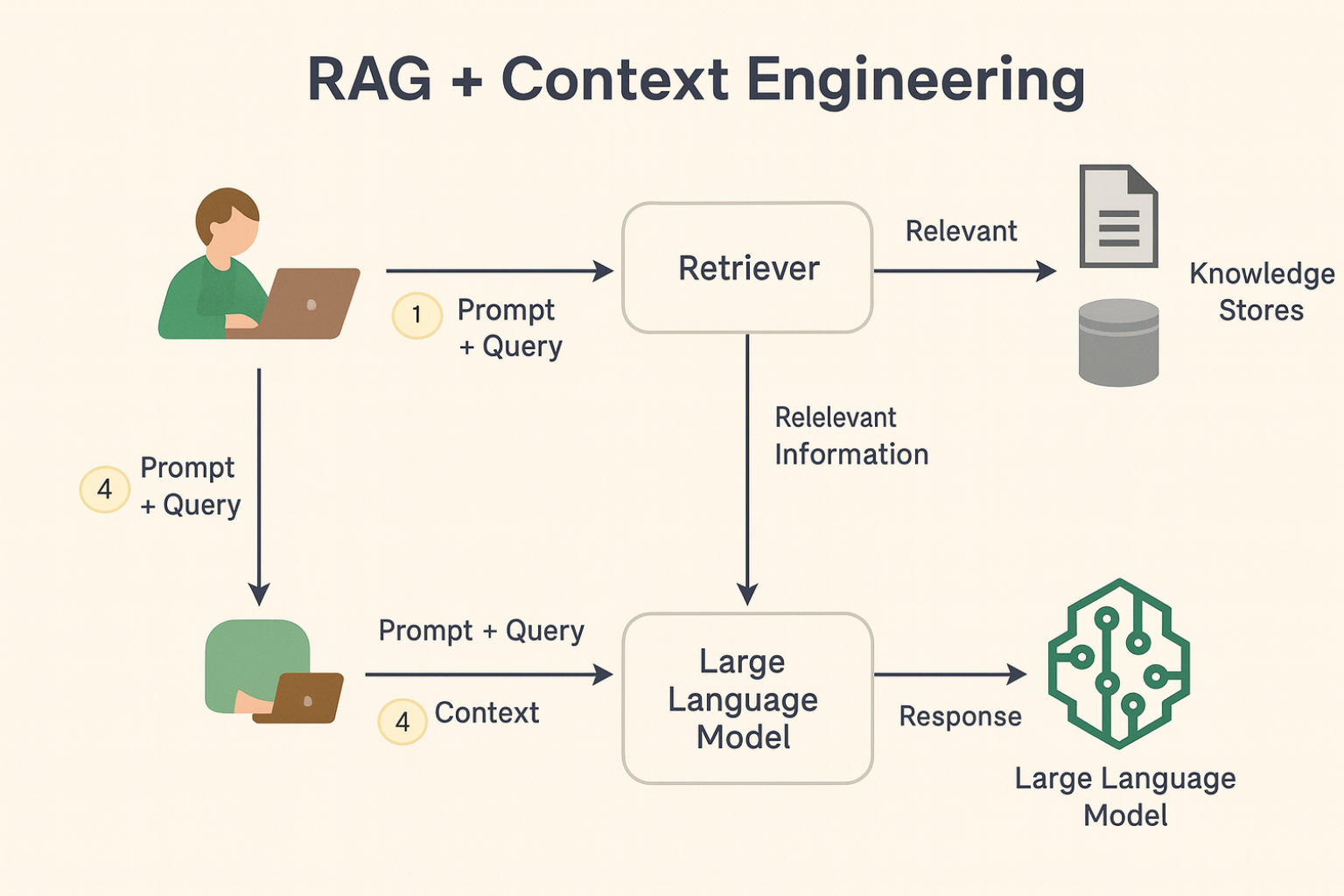
RAG and Context Engineering: A Powerful Combination
RAG (Retrieval-Augmented Generation) is a technique that enhances the performance of programming language models by allowing external data to be queried before generating a response.
This means that, instead of relying solely on what the model was trained on, the system searches for information in up-to-date and contextualized sources.
Context engineering acts as a facilitator of this integration: it organizes documents for consultation, defines what should be retrieved, how and when, and ensures that only relevant data is inserted into the context of the generation.
A good example of applying RAG with context engineering is the implementation of chatbots with access to corporate knowledge bases.
They are able to respond accurately, citing up-to-date documents, internal policies, and manuals, based on well-established contextual rules.
Context Engineering vs. Prompt Engineering: A Strategic Comparison
Although often confused, these two disciplines have distinct and complementary roles.
While prompt engineering focuses on how the instruction is written, context engineering takes care of preparing and organizing the data surrounding that instruction.
Prompt Engineering:
Focus on the language and textual structure of the command. Ideal for adjusting the immediate output of the template.
Context Engineering:
Focus on the informational environment. Ideal for scalability, customization, and long-term consistency.
When applied together, they form a robust foundation for creating truly effective autonomous agents.
Key Context Failures and How to Mitigate Them
Despite its power, context engineering is subject to several technical problems that can compromise system performance. Among the main ones are:
Context Contamination
This occurs when the system receives irrelevant, redundant, or contradictory information within the same prompt or extended context, compromising the quality, accuracy, and usefulness of the generated response.
That Contamination This can result from poorly structured documents, unreliable sources, or overly broad search settings in RAG systems.
When this happens, the model may mix conflicting instructions, generate generic or even incorrect responses, creating an inconsistent user experience.
This flaw is especially critical in sensitive environments such as legal, medical, or financial, where the slightest error in contextual interpretation can have considerable real-world impacts.
Mitigation: Use of semantic filters, refined embeddings, and active database curation.
Context Distraction
This happens when the AI agent prioritizes superficial or irrelevant parts of the provided context, failing to consider essential data for an accurate and useful response.
This flaw can arise from poor prioritization of contextual data, absence of semantic weighting mechanisms, or even from an excess of ancillary information that diverts the focus of the model.
A classic example occurs when a chatbot focuses on generic data about a customer's profile and ignores crucial details such as purchase history or specific preferences.
This type of distraction directly compromises the quality of the response and reduces the effectiveness of applying AI to more complex tasks.
Mitigation: Hierarchical structuring of the context with weights and priorities, as well as organization by key topics.
Confusion of Context
This refers to moments when multiple distinct topics, tasks, or intentions are introduced.according to the Multi-Task Inference study) in the same input or prompt, resulting in overlapping instructions that confuse the model.
This flaw manifests itself, for example, when an agent receives the request: "generate a sales proposal and update the client's status in the CRM".
By failing to identify priorities, boundaries, and hierarchy among tasks, the model may only perform one of them, mix information, or even fail completely.
This confusion directly impacts the agent's reliability and can be exacerbated in more complex automation pipelines, where a clear separation of intents is vital for orchestrating flows.
Mitigation: Modularization of the context and separation of input streams for different tasks or steps.
Conflict of Context
This occurs when two or more instructions, data, or premises within the same context present explicit or implicit contradictions, forcing the model to make decisions without clear priority criteria.
This conflict can occur, for example, when a system simultaneously receives information that a customer is entitled to a 10% discount and, in another segment, that they do not have any active benefits.
This ambiguity leads the model to generate inconsistent or erratic outputs, or even to freeze during task execution.
In more critical pipelines, such as financial automation or AI-assisted medical diagnoses, unresolved context conflicts can lead to serious consequences.
Therefore, the ability to detect, resolve, and prevent these conflicts is essential to ensuring the reliability and security of intelligent systems.
Mitigation: Automated validation of logical consistency and use of precedence rules on the provided data.
Tools for Context Engineering
The evolution of the no-code and low-code tools has greatly facilitated the application of context engineering in real-world scenarios. Some of the most commonly used tools include:
- LangChainA library specializing in the creation of agents and contextual flows.
- LlamaIndex: Tool for intelligent indexing of data and documents.
- Dify.aiA platform that integrates RAM, memory, workflows, and interfaces.
- make up (Integromat)To automate the retrieval and organization of contextual data.
- n8nAn open-source alternative for orchestrating contextual flows.
THE AI Agent and Automation Manager Training The No Code Startup is a complete option for those who want to master these tools with a focus on practical applications.
Real-World Applicability: Where Context Engineering Generates Value
The adoption of context engineering has grown on several fronts. Some applications with significant results include:
- Customer serviceReduced response time and increased satisfaction through personalized interactions.
- Automated consultingAgents who offer diagnoses and recommendations based on real customer data.
- Personalized educationAdaptive platforms that deliver content based on learning history.
- Compliance and auditingRobots that analyze documents and processes based on updated regulations and policies.
To explore more about specific applications in generative AI, see the article. What are AI agents? Everything you need to know
Trends: The Future of Engineering in Context
The future points to a convergence between contextual engineering, long-term memory and situational intelligence.
With the evolution of LLMs (Large Language Models), it is expected that AI systems will come to operate with near-human capabilities to maintain and apply lasting contexts.
Another emerging point is the multimodal context engineering: to integrate visual, voice, text, and sensor data into a single contextual database.
This opens up opportunities for agents operating in complex environments such as healthcare, industry, and logistics with an unprecedented level of autonomy.
Mastering Context Engineering to Create Intelligent Agents
Mastering context engineering is more than a competitive advantage: it's a fundamental requirement for building AI agents that solve real-world problems efficiently and with personalization.
By understanding how to intelligently structure, automate, and retrieve context, you radically expand what's possible to create with generative AI.
If you want to learn more and put this into practice, also explore... SaaS IA NoCode Training and immerse yourself in a universe where context engineering is not just theory, but a powerful tool for low-cost, high-impact digital transformation.
















 EN
EN  PT
PT  ES
ES 