
Hey everyone! Matheus Castelo Here, founder of NoCode StartUp and official Lovable ambassador in Brazil.
Lovable has just launched an incredible new feature that will change the game: Lovable Cloud. They are combining the front-end, which we already know and love, with the entire back-end structure, making project creation much more practical.
In this article, I'll show you what Lovable Cloud is, its pros and cons, and most importantly: when you should use it and when good old Supabase is still the best option. Let's go!
What is Lovable Cloud?

For those who don't know, the back-end is one of the most important parts of any technology project. It's the brain of the application, where the data, logic, and security reside.
What Lovable did was take all the complexity of Supabase—which is a fantastic back-end tool—and integrate it in a simplified way within their platform. With this, we can now create projects... full-stack (with front-end and back-end) all in one place.
This means you can manage your application's database, files, users, and security without leaving the Lovable environment. The idea is to make life easier, especially for those who are just starting out.
Testing in practice
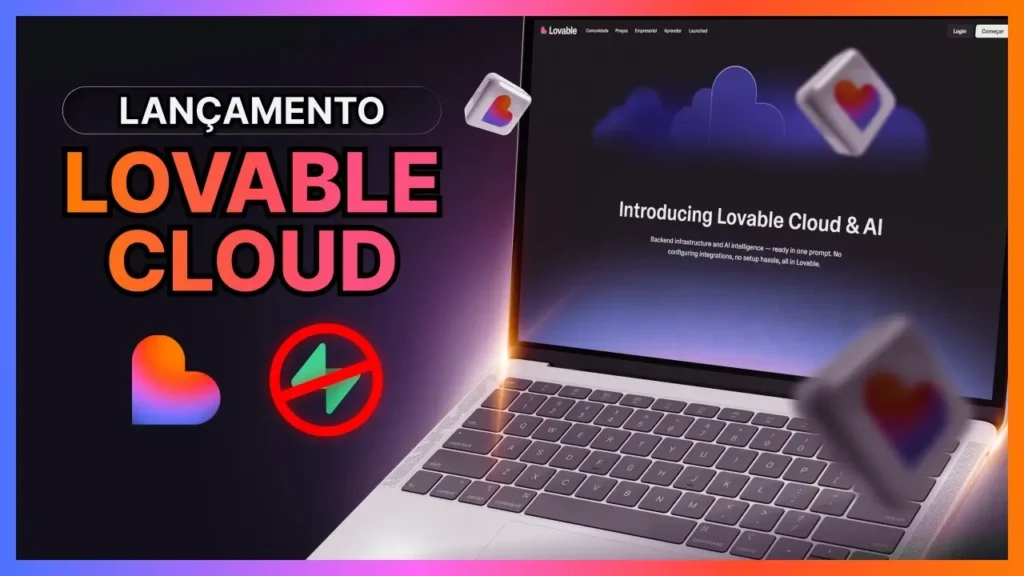
To see how everything works, I created a prompt and asked Lovable's AI (Artificial Intelligence) to build an app for me using the new Lovable Cloud. The project was a "Fit Tracker," a simple app for tracking gym goals.
In just two minutes, the app was up and running! I was able to create my account, log in, set weight and body fat percentage goals, and even record my daily meals and workouts. Everything was created automatically, including the database.
Exploring the new “Cloud” tab on the platform, I could see that everything was there in an organized way: the database tables, the user authentication settings, and even the security rules, which define what each person can do in the app. It became really very practical.
Positive and negative points

After testing, it became clear that the Lovable Cloud It has important advantages and disadvantages to consider.
The big positive point is the practicality. The setup is fully automated, allowing you to launch a project or an MVP (Minimum Viable Product) in minutes, without worrying about back-end infrastructure. It's perfect for beginners.
On the other hand, the downside is the loss of control. You become more dependent on the Lovable platform, which can be a risk. lock-in. Furthermore, the billing model is based on usage (pay-as-you-go), which makes costs less predictable as your application grows.
Lovable Cloud vs. Supabase?

So the big question is: should I use the Lovable Cloud or continue using Supabase independently? The answer depends on your project.
Lovable Cloud wins hands down in ease and speed of setup. In contrast, the Supabase offers complete control, autonomy, and cost predictability., with its fixed plan of $25 per month and the option to be self-hosted (open source).
In terms of scalability, Supabase is an extremely robust and high-performance solution, built to handle the demands of large and complex projects. Lovable Cloud also scales, but its costs increase with usage.
Which one to choose?
My final recommendation is quite straightforward and based on your current situation and the type of project you are building.
Choose Lovable Cloud if:
You're just starting out, want to learn quickly, need to validate an idea with a simple MVP, or don't want the headache of infrastructure. The ease of use here is unbeatable.
Choose Supabase (independent) if:
You're working on a more serious, robust, and professional project. You need cost predictability, complete technical control, and want to avoid dependence on a single platform. For me, mastering Supabase is a superpower in the No-Code world.
I hope this review has helped! I want to know what you thought of this release, so comment below if you agree with me.
And if you want to learn how to create AI projects from scratch to advanced, with the best tools on the market, You are invited to visit the AI Coding Training.

















 EN
EN  PT
PT  ES
ES