

In the context of 2025, where the speed of information and the personalization of the consumer experience are crucial competitive differentiators, the use of AI agent for digital marketing It has ceased to be a trend and has become a fundamental reality.
According to a McKinsey report on AI adoption in marketing, These agents not only automate tasks, but also make autonomous decisions based on data, behaviors, and business objectives.
In this comprehensive guide, you will discover how they work, what they are used for, which tools to use, and why companies that master this technology are light years ahead of the competition.
Contents

What is an AI agent for digital marketing?
One AI agent for digital marketing It is an autonomous entity based on artificial intelligence that operates with partial or total autonomy in marketing processes, such as lead generation, audience segmentation, content creation, data analysis, and campaign execution.
To better understand the concept, it's worth consulting this. academic definition of intelligent agents. These agents use machine learning models and natural language processing to understand behaviors and respond in a personalized way at scale.
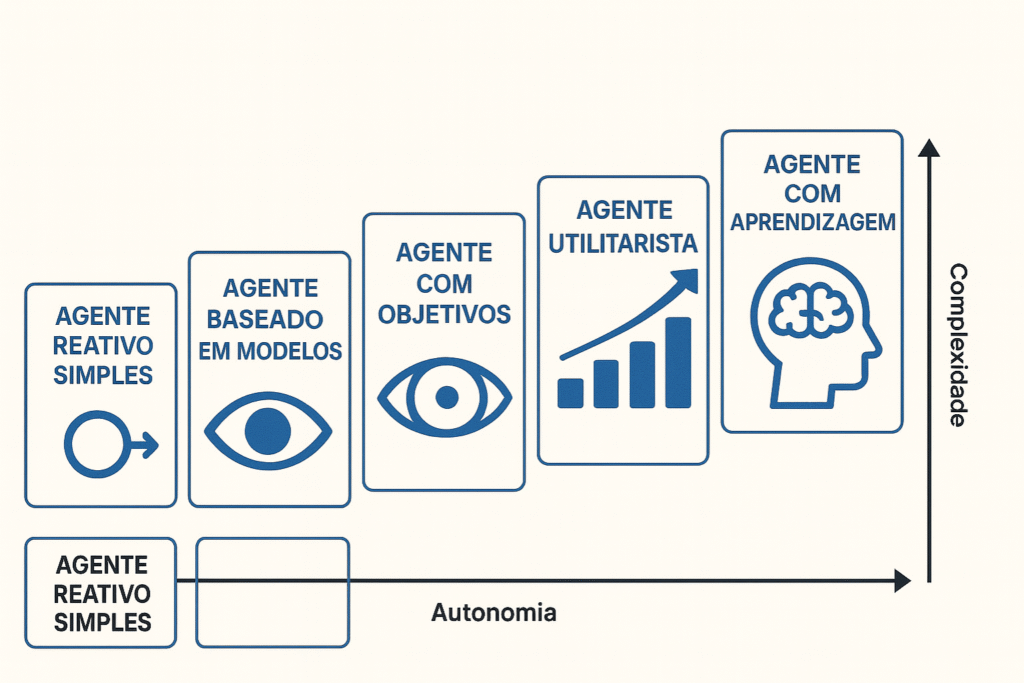
Unlike simple automations, such as scheduled emails or response bots, AI agents are able to learn from past interactions, adapt their strategies, and act based on real-time metrics.
A classic article from Harvard Business Review on adaptive automation This highlights the natural evolution of data-driven digital marketing.
How do intelligent agents work in modern marketing?
AI agents operate by integrating internal data (CRM, ERPs, funnels) with external data (market trends, social networks, user behavior).
For a technical dive, the CDP Institute It maintains a comprehensive guide on the governance of this data. From this database, agents can make decisions and perform tasks independently.
For example, an agent can:
- Detect that a lead has visited a pricing page three times and has not yet converted;
- Personalize an email with a specific offer based on past behavior;
- Monitor email open rates and interaction, and reschedule follow-up if the lead clicks or ignores the email.
This adaptive logic is what allows for a truly customer-centric marketing experience.
Tools and platforms that utilize AI agents.
In 2025, some of the most relevant tools for creating and managing AI agents for marketing include:
Make (Integromat)
With its visual approach and integration with thousands of apps systems, it's possible to create agents that react to events in CRMs, landing pages, and e-commerce platforms. Learn more about it. official Make website to explore advanced integrations.
O No Code Start Up Makeup Course (Integromat) It teaches exactly how to build these smart routines.
Agents with OpenAI and Dify
Using GPT-40 models and tools such as Agents Course with OpenAI, It is feasible to create agents that write copy, converse with leads in real time, and analyze sentiment in comments.
THE OpenAI documentation it's the Official guide to Dify They show how these agents can be deployed with logical flows and contextual memory.
Salesforce Einstein & HubSpot AI
Established platforms have also made progress in adopting AI. Salesforce Einstein for Marketing It recommends customized automations based on historical data, while the HubSpot AI Detects cross-selling opportunities in real time.

Real-world use cases of AI agents in digital campaigns.
E-commerce with predictive AI
The online retailer Dafiti has implemented an AI agent to recommend personalized products in emails based on purchase and browsing history.
According to Detailed case study published in TI Inside, The initiative not only increased the conversion rate by 28 %, but also provided reduction of operational costs of up to 80% % and significant gains in agility in campaign execution.
B2B demand generation
Companies like Resultados Digitais (RD Station) have implemented agents that identify leads most likely to convert based on behavioral signals.
O RD Station official case This demonstrates the reduction in commercial response time achieved by 40%.
Social listening with autonomous response
Brands like Netflix use agents that monitor social media and automatically react to mentions with content suggestions or humorous responses.
THE Brand24 analyzed how Netflix dominates social media. analyzed this strategy and its impact on engagement.
Strategic benefits of AI agents in digital marketing.
Companies that correctly implement AI agents are able not only to scale their operations, but also to dramatically increase the efficiency of their campaigns. A report from Deloitte on personalization at scale. proves gains such as:
- Customization at scale: Each user receives interactions tailored to their profile and stage in the journey.
- Real-time decisions: Optimizing campaigns as the data changes.
- Reducing operational costs: Less need for giant teams for tactical execution.
- Learning speed: The agents improve as they operate, creating a positive feedback loop.

Trends for 2025 and beyond in the use of intelligent agents.
With the popularization of multimodal AI models and the concept of "autonomous marketing," the Gartner — Marketing Predictions 2025-2028 It projects an explosion in the adoption of specialized agents by channel (email, social media, SEO, CRM).
Another key point is the integration between AI and no-code interfaces, allowing marketing professionals to create their own agents without relying on developers.
Platforms like official Bubble manual it's the Dify Course They allow this construction in an intuitive way.
Innovations are also expected, such as agents with distinct personalities for each campaign, and regulation of generative AI — including initiatives like the EU AI Act — and advances in AI that encompass irony, humor, and deep brand context.
Moving forward with AI agents in marketing requires preparation.
It is clear that the use of AI agent for digital marketing This represents a clear competitive advantage in 2025.
However, successful implementation requires technical understanding, clarity of objectives, and choosing the right tools.
If you want to master these skills, see the No Code Start Up training programs And start creating your first agents with a focus on performance, scale, and true personalization.














 EN
EN  PT
PT  ES
ES 