ASSINATURA PRO COM DESCONTO

Hours
Minutes
Seconds

BLOG

Create image with artificial intelligence. It has become one of the most accessible, fast, and creative ways to generate visual content in 2025. While previously it required mastering complex design tools, today it's possible to produce illustrations, logos, concept art, and promotional images simply by describing what you want to see.

With the advancement of generative AI models and no-code platforms, this process has become even more accessible for beginners, freelancers, and entrepreneurs.

In this comprehensive guide, you'll understand how AI-powered image creation works, which tools are dominating the market, how to automate visual generation with intelligent integrations, and, most importantly, how to practically apply this to your business or personal project.

What are AI-powered image generators?

What are artificial intelligence image generators?

Artificial intelligence-powered image generators are systems based on neural networks capable of creating images from natural language descriptions.

These descriptions, called prompts, These images are interpreted by AI which, based on gigantic databases and deep learning algorithms, composes coherent, original, and realistic images.

Models such as DALL·E, Stable Diffusion, and Leonardo.AI They are already being used by artists, developers, agencies, and companies to accelerate the creation of visual material.

Starting with text such as "astronaut dog on Mars, futuristic digital art style," these generators can produce in seconds an image that would take hours using traditional tools.

This technology is part of the generative AI universe, the same family as text models like ChatGPT.

When integrated with no-code tools, it becomes an incredible resource for product prototyping, visual identity creation, branding, and marketing content.

Advantages of creating images with artificial intelligence.

The adoption of AI-powered image generators has grown not only because of the innovation involved, but also because of the real advantages they offer:

  • SpeedImages created in seconds, from ideas you can describe in words.
  • AccessibilityIt does not require technical knowledge in design, drawing, or image manipulation.
  • Cost reductionIt avoids the need to hire designers for simple tasks.
  • Creative freedomThe possibility of exploring artistic styles, unreal scenarios, and visual concepts impossible in the real world.
  • Rapid iterationYou can test dozens of visual variations with slight changes to the prompts.

Tools for creating images with AI (besides Midjourney)

Tools for creating images with AI (besides Midjourney)

DALL·E (via ChatGPT or integrations)

Although Midjourney is one of the best-known names, there are several other powerful and affordable platforms. Here are some of the most relevant ones currently available:

Developed by OpenAI, DALL·E is directly integrated with ChatGPT, allowing for prompt-based image generation within the conversation. It can also be used via automations with Make or N8N.

Discover the Agents with OpenAI course from No Code Startup.

Leonardo.AI

Leonardo.AI
Leonardo.AI

With an accessible interface and a focus on illustrations and digital art, it's excellent for those who want to create stylized or more artistic images. Ideal for games, apps, or creative projects. Access Leonardo.AI

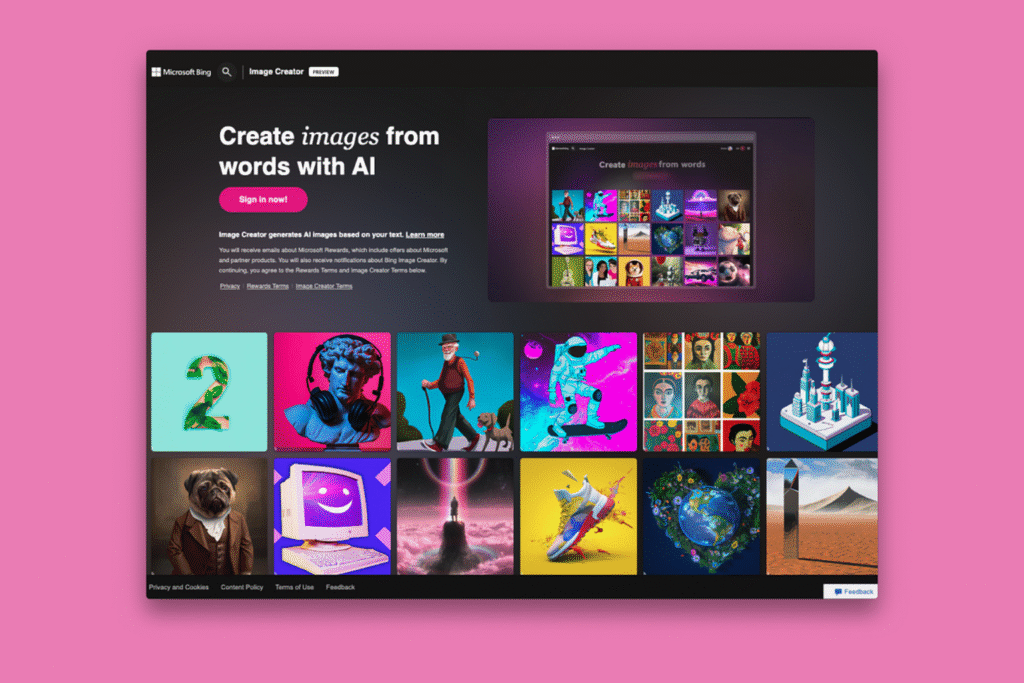
Bing Image Creator (Microsoft)
Bing Image Creator (Microsoft)

Based on DALL·E, it offers free and simple access via a web browser. It's ideal for beginners who want to explore without cost. Try Bing Image Creator

Looka
Looka
Looka

Specifically designed for creating logos and visual identities. Widely used by founders who need a quick visual identity to validate ideas. Get to know Looka

Designs.ai
Designs.ai
Designs.ai

A complete design tool with AI features for creating logos, banners, and promotional materials. Learn more about Designs.ai

How to automate image generation with AI and no-code

The real magic happens when you integrate image generators with automated workflows. With tools like make up and N8N, It is possible:

  • Create images automatically based on form responses.
  • Generate personalized visuals for each new lead captured.
  • Building landing pages with dynamic images using Bubble or WebWeb
  • Feeding image banks in apps created in FlutterFlow

Learn how to integrate these automations in the Make Course.

Practical examples and real-world applications

Freelancer creating complete landing pages in 48 hours.

Imagine you're a freelancer and you need to deliver a website to a client in record time. Using the Bubble together with DALL·E, It is possible to generate unique images for each section of the landing page, tailored to the brand's style.

With AI-generated text, the end result is a cohesive, visually appealing website delivered quickly.

Entrepreneur testing the visual identity of an MVP.

Entrepreneurs who want to validate their MVP can use the Looka to create a professional logo and the Leonardo.AI to generate conceptual interface images and personas. This helps to test visual hypotheses with the target audience, without relying on agencies or design professionals.

Beginner exploring styles and building a portfolio.

Even beginners can use it. Bing Image Creator to experiment with different artistic styles, practice prompts, and build a visual portfolio to share on social media or websites such as Behance and Dribbble. A great gateway into the creative world of AI.

Content creator automating asset generation.

Influencers and content creators can integrate make up + DALL·E to automatically generate video covers, thumbnails, and visual posts based on content calendars.

This automation allows you to maintain a consistent posting frequency with high-quality visuals, without constant manual effort.

Trends for the future of visual creation with AI.

The integration between artificial intelligence and no-code platforms is just the beginning. Autonomous agents are emerging that combine text, image, and voice AI to create complete experiences.

Tools like Dify and Agents Course with OpenAI They show how to assemble these agents without writing code.

Soon, it will be common to see brands creating entire campaigns generated automatically: images, text, captions, emails, and landing pages. All aligned with a well-defined prompt and an efficient automation workflow.

Ready to create AI-powered images for your project?

Ready to create AI-powered images for your project?

Creating images with artificial intelligence is no longer something futuristic — it's an accessible, productive, and incredibly powerful reality for anyone who wants to accelerate projects, sell more, or simply explore their creativity.

Whether you're a freelancer or a beginner, now is the perfect time to explore this world. And if you want to learn by doing, with guided examples, check out the courses from No Code Start Up:

Explore, combine, experiment. The perfect image is just a prompt away.

AI-powered image generation is revolutionizing how we create visual content. Learn more How to use DALL-E Today, it is an extremely valuable skill for creators, freelancers, entrepreneurs, and those curious about technology.

In this comprehensive guide, you will understand how this OpenAI tool works, learn how to use it step-by-step, and discover practical ways to apply DALL-E to real-world projects, even without programming knowledge.

What is DALL E and how does it work?
Prompt used: A retro metal robot paints the Mona Lisa on an easel in a cozy studio; hyper-realistic 3D rendering, warm lighting, a classical bust to the side, abstract paintings in the background.

What is DALL-E and how does it work?

DALL-E is an artificial intelligence model developed by OpenAI Capable of generating images from textual descriptions. The tool has evolved considerably since its first version, and today it can be accessed both directly and integrated into... ChatGPT with Plus plan, offering options for editing, variation, and generation via prompts.

He understands the context of the description and transforms words into coherent, stylized, or hyper-realistic images.

Furthermore, it is possible edit existing images using resources such “inpainting” (replacement of parts of the image) directly in the visual interface integrated into ChatGPT.

Where to use DALL-E in practice

Inside ChatGPT

If you subscribe to the ChatGPT Plus plan, you can already use DALL-E directly in the interface. Simply write a detailed prompt, such as:

“"A futuristic city at dusk, in steampunk style, with people riding flying bicycles."”

After generating the image, you can click on it to open the editing tool, replace elements, or generate variations.

Using DALL-E via API and no-code tools

For those who wish to automate or integrate image generation in apps, it is possible to connect DALL-E via API using platforms such as:

  • Make (Integromat)Allows you to create automated image generation workflows in response to events, spreadsheets, or forms.
  • DifyBuild interfaces that use prompts to generate images directly with AI.
  • Agents Course with OpenAICreate agents that receive voice or text commands and automatically return images.
Practical examples of how to use DALL E

Practical examples of how to use DALL-E

Creating YouTube thumbnails with AI

By describing the video's concept (theme, color, expressions), DALL-E can generate an illustrative image that stands out in the feed. For example:

“"Man surprised by laptop in front of high-frequency graph, colorful background, cartoon style."”

With minor later edits in Canvas Using Photoshop, you can have a professional thumbnail generated in minutes.

Product mockups

Entrepreneurs can use DALL-E to create visual representations of products that don't yet exist. A prompt like:

“"Smart bottle with LED screen, on top of a minimalist wooden table, blurred background."”

It's sufficient to visually validate ideas before investing in professional design.

Scaled image generation with N8N

Imagine a workflow where, by filling out a spreadsheet with product descriptions, you automatically generate an image for each product. This is possible with... N8N OpenAI API. Ideal for e-commerce or digital catalogs.

How to create an app with an AI-powered image generator
Prompt used: A retro metal robot and a young programmer exchange ideas in a cozy home office; photorealistic 3D rendering, warm lighting, a bright spiral hologram between them, open-source laptop.

How to create an app with an AI-powered image generator

Bubble

O Bubble no-code is one of the most complete platforms for those who want to create web applications with sophisticated business logic. With it, it is possible to structure customized workflows and integrate the DALL-E API to allow the end user to insert descriptions and receive images generated in real time.

This approach is ideal for creating internal tools, SaaS products, or visual MVPs with great agility.

WebWeb

WeWeb stands out for its responsive design and excellent user experience. It allows for great creative freedom in building the app's visual interface, while the backend can be connected via Xano or other APIs, including DALL-E.

The difference of WebWeb Its ability to create highly optimized appss for both mobile and desktop devices makes it ideal for appss aimed at the end consumer.

FlutterFlow

FlutterFlow is a powerful platform for creating mobile applications with native performance, using the foundation of Google's Flutter. By integrating DALL-E with FlutterFlow, You can build apps for Android and iOS that generate AI-powered images from user descriptions.

It's an ideal choice for those who want to distribute their app on stores like Google Play or the App Store with impressive visual features.

Future trends and advanced uses of DALL-E

The trend is for AI-powered visual generation to become even more personalized, responsive, and interactive. Some ongoing innovations include:

  • Real-time generation based on voice commands.
  • Customization with brand styles and unique visual identity.
  • Integration with Augmented Reality (AR) and Metaverse.

These innovations open doors for those who master tools like DALL-E from now on.

Why you should start using DALL E today.
Prompt used: Retro painter robot holding a color palette displays paintings; large rainbow spiral shines in the background; smiling man in orange sweater works on laptop and digital tablet; vintage cartoon style in paper texture, warm colors.

Why you should start using DALL-E today.

Know How to use DALL-E It's one of the fastest and most accessible ways to enter the world of applied AI. You can generate professional images, innovate in projects, save on design costs, and even create new digital products.

Regardless of your profile or objective, DALL-E is a powerful bridge between ideas and visualization, allowing you to explore the world of creative AI quickly and efficiently.

To delve deeper and apply this knowledge professionally, explore these courses:

THE prompt engineering or prompt engineering Today, this is the key skill for extracting practical intelligence from generative models like GPT-4O. The better the instruction, the better the result: more context, less rework, and truly useful answers.

Mastering this subject expands creativity, accelerates digital product development, and opens up a competitive advantage. In this guide, you will understand the fundamentals, methodologies, and trends, with applicable examples and links that delve deeper into each topic.

What is Prompt Engineering?

What is Prompt Engineering?

THE prompt engineering It consists of designing carefully structured instructions to guide artificial intelligence toward accurate, ethical, and goal-aligned outputs.

In other words, it's the "conversational design" between humans and AI. The concept gained traction as companies realized the direct relationship between the clarity of the prompt and the quality of the delivery.

From simple chatbots, like the historic ELIZA, to multimodal systems, the evolution underscores the importance of best practices. Want an academic overview? The OpenAI official guide shows experiments of few-shot learning and chain-of-thought in detail

Linguistic and Cognitive Foundations

Linguistic and Cognitive Foundations

Language models respond to statistical patterns; therefore, each word carries semantic weight. Ambiguity, polysemy, and token order influence AI comprehension. To reduce noise:

Use specific terms instead of generic ones.

— State the expected language, format, and tone.

— Debt context in logical blocks (strategy chaining).

These precautions reduce vague responses, something proven by research from... Stanford HAI who analyzed the correlation between syntactic clarity and output accuracy.

Want to practice these techniques with zero code? A AI Agent and Automation Manager Training It offers guided exercises that start at the basics and progress to advanced projects.

Practical Methodologies for Constructing Prompts

Prompt Sandwich

The Prompt-Sandwich technique consists of structuring the prompt into three blocks: contextual introduction, clear examples of input and output, and the final instruction asking the model to follow the pattern.

This format helps the AI understand exactly the type of response desired, minimizing ambiguities and promoting consistency in delivery.

Chain‑of‑Thought Manifesto

This approach prompts the model to think in steps. By explicitly asking the AI to "reason aloud" or detail the steps before reaching a conclusion, the chances of accuracy are significantly increased – especially in logical and analytical tasks.

Google Research studies prove gains of up to 30% in accuracy with this technique.

Self-Assessment Criteria

Here, the prompt itself includes parameters for evaluating the generated response. Instructions such as "check for contradictions" or "evaluate clarity before finalizing" cause the model to perform a kind of internal review, delivering more reliable and refined outputs.

To see these methods in action within a mobile application, check out the case study on our website. FlutterFlow course, where each screen brings together reusable prompts integrated with the OpenAI API.

Essential Tools and Resources

Essential Tools and Resources

In addition to OpenAI's Playground, tools such as PromptLayer They perform versioning and cost analysis per token. Programmers, on the other hand, find it in the library. LangChain a practical layer for composing pipelines complex.

If you prefer solutions no-code, platforms such as N8N They allow you to encapsulate instructions in clickable modules – a complete tutorial is available on our website. N8N Training.

It's also worth exploring open-source repositories on Hugging Face, This is where the community publishes prompts optimized for models like Llama 3 and Mistral. This exchange accelerates the learning curve and expands the repertoire.

Use Cases in Different Sectors

Customer SuccessPrompts that summarize tickets and suggest proactive actions.

Marketing: generating targeted campaigns, exploring personas built via SaaS IA NoCode.

Health: symptom screening with human medical validation, following guidelines from European AI Act For responsible use.

EducationInstant feedback in writing, highlighting areas for improvement.

Notice that all scenarios begin with a refined instruction. That's where prompt engineering reveals its value.

Future Trends in Prompt Engineering

Future Trends in Prompt Engineering

The horizon points to prompts multimodal capable of orchestrating text, image, and audio in a single request. In parallel, the concept of [missing word - likely "techniques" or "techniques"] emerges. prompt-programming, where the instruction is transformed into executable mini-code.

Architectures open-source as Mixtral They encourage communities to share standards, while regulations require transparency and mitigation of biases.

O study by Google Research It also indicates that dynamic prompts, adjusted in real time, will empower autonomous agents in complex tasks.

Practical Results with Prompt Engineering and Next Professional Steps

THE prompt engineering It has gone from being a technical detail to a strategic factor. Mastering linguistic principles, applying tested methodologies, and using the right tools multiplies productivity and innovation – whether you are a founder, freelancer, or intrapreneur.

Ready to take your skills to the next level? Discover... SaaS IA NoCode Training From No Code Start Up – an intensive program where you build, launch, and monetize products equipped with advanced prompts.

DeepSeek It has become one of the most talked-about topics of 2025. Even for those already familiar with LLMs (Large Language Models), there is still much to discover about the Chinese team's proposal and, especially, How to apply today in projects of No Code and AI, without complicating things.

What is DeepSeek?
What is DeepSeek?

Quick summary: DeepSeek offers a family of open-source models (7B/67B parameters) licensed for research, a specialized code generation arm (DeepSeek Coder), and an advanced reasoning variant (DeepSeek-R1) that rivals heavyweights like GPT-40 in logic and mathematics. Throughout this article you will discover what is it?, how to use, why does it matter and opportunities in Brazil.

What is DeepSeek?

In essence, DeepSeek is a LLM open-source (for community research) developed by DeepSeek-AI, an Asian laboratory focused on applied research. Initially launched with 7 billion and 67 billion parameters (7B/67B), the project gained notoriety by releasing complete checkpoints on GitHub, allowing the community to:

  1. Download Weights are free of charge for research purposes;
  2. Do fine-tuning Local or cloud-based;
  3. Incorporate The model in applications, autonomous agents, and chatbots.

This puts it on the same level as initiatives that prioritize transparency, such as LLaMA 3 From Meta. If you are not yet familiar with the concepts of parameters and training, check out our internal article. “"What is an LLM and why is it changing everything?"” to get your bearings.

The innovation of DeepSeek LLM Open-Source

DeepSeek's distinguishing feature isn't just its open-source code. The team has published a pre-training process in 2 trillion tokens and adopted techniques of curriculum learning which prioritize higher quality tokens in the final stages. This resulted in:

  • Lower perplexity equivalent models with 70 B parameters;
  • Competitive performance in reasoning benchmarks (MMLU, GSM8K);
  • More permissive license which rivals Apache 2.0.

For technical details, see the paper official on arXiv and the repository DeepSeek-LLM on GitHub

DeepSeek-R1: The leap into advanced reasoning.

A few months after its launch, the DeepSeek-R1, a “refined” version with reinforcement learning from chain‑of‑thought (RL-CoT). In independent assessments, R1 reaches 87 % accuracy in basic math test, surpassing names like PaLM 2-Large.

This enhancement positions DeepSeek-R1 as an ideal candidate for tasks that require structured logic, planning and step-by-step explanation common requirements in expert chatbots, study assistants and autonomous agents AI.

If you'd like to create something similar, it's worth taking a look at our... AI Agent and Automation Manager Training, where we show how to orchestrate LLMs with tools such as LangChain and n8n.

DeepSeek Coder code generation and comprehension

DeepSeek Coder: Code generation and comprehension

In addition to the general language model, the laboratory launched the DeepSeek Coder, trained in 2 trillion tokens from GitHub repositories. The result? A specialized LLM capable of:

  • Complete functions in multiple languages;
  • Explaining legacy code snippets in natural language;
  • Generate unit tests automatically.

For teams freelancer and B2B agencies For those who provide automation services, this means increasing productivity without inflating costs. Want a practical way to integrate DeepSeek Coder into your workflows? Learn more in the course. Xano for Scalable Backends We demonstrate how to connect an external LLM to the build pipeline and generate intelligent endpoints.

How to use DeepSeek in practice

Even if you're not a machine learning engineer, there are accessible ways to try DeepSeek today.

1. Via Hugging Face Hub

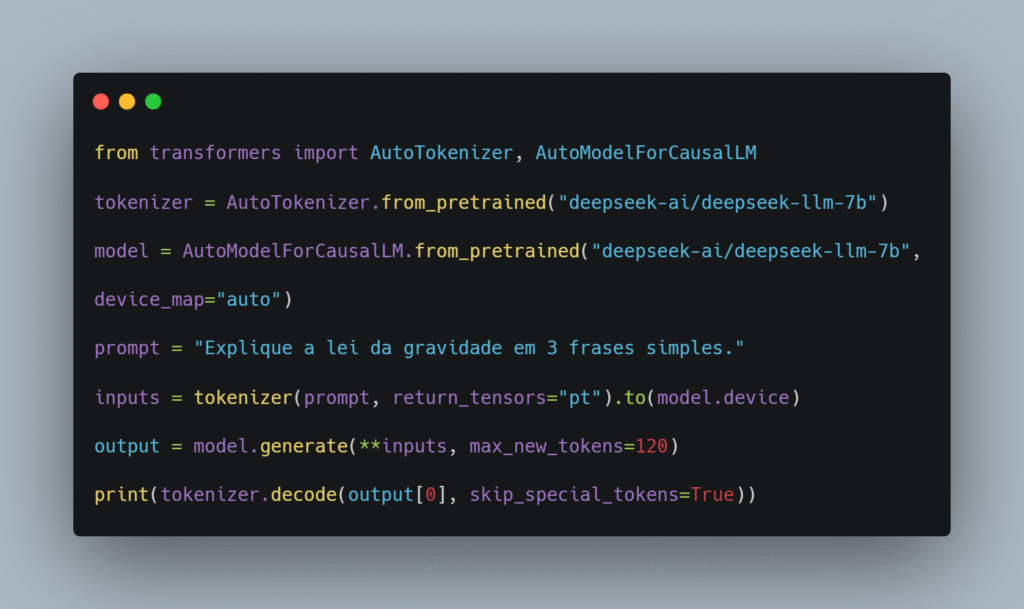
The community has already mirrored the artifacts in Hugging Face, allowing free inference for a limited time. All you need is an HF token to run local transformer calls.

DeepSeek Hugging Face Hub

Tip: If the model doesn't fit on your GPU, use 4-bit quantization with Bits and Bytes to reduce memory.

2. No-Code Integration with n8n or Make

Visual automation tools such as n8n and make up They allow HTTP calls in just a few clicks. Create one. workflow what:

  1. Receives input from Webflow or Typeform forms;
  2. Send the text to the DeepSeek endpoint hosted in the company's own cloud;
  3. Returns the translated response in Brazilian Portuguese and sends it to the user via email.

This approach eliminates the need for a dedicated backend and is perfect for founders who want to validate an idea without investing heavily in infrastructure.

3. Plugins with FlutterFlow and WeWeb

If the goal is a polished front-end, you can embed DeepSeek in FlutterFlow or WebWeb using HTTP Request actions. In the advanced module of FlutterFlow Course We explain step-by-step how to protect your API key in Firebase Functions and avoid public exposure.

DeepSeek in Brazil: Scenario, Community, and Challenges

DeepSeek in Brazil: landscape, community, and challenges

The adoption of open-source LLMs here is growing at an accelerated pace. Research groups at USP and UFPR are already testing DeepSeek for... abstracts of academic articles in Portuguese. Furthermore, the group DeepSeek-BR on Discord, there are over 3,000 members exchanging fine-tuning tips focused on... Brazilian jurisprudence.

Curiosity: Since March 2025, AWS São Paulo has been offering g5.12xlarge instances at a promotional price, enabling fine-tuning of DeepSeek-7B for less than R$ 200 in three hours.

Real-world use cases

  • E-commerce niche market using DeepSeek-Coder to generate batch product descriptions;
  • SaaS legal which runs RAG (Retrieval-Augmented Generation) on summaries of the STF (Supreme Federal Court);
  • Support chatbot Internal consultant at CLT (Consolidation of Labor Laws) companies for HR-related questions.

For a practical overview of RAG, read our guide. “"What is RAG – IA Dictionary"”.

Strengths and limitations of DeepSeek

Advantages

Zero cost for research and prototyping.

One of the biggest advantages of DeepSeek is its open license for academic and research use. This means you can download, test, and adapt the model without paying royalties or relying on commercial vendors. Ideal for early-stage startups and independent researchers.

Lean models that run locally

With versions featuring 7 billion parameters, DeepSeek can run on more affordable GPUs, such as the RTX 3090, or even via 4-bit cloud quantization. This broadens access to developers who lack robust infrastructure.

Active and contributing community

Since its launch, DeepSeek has accumulated thousands of forks and issues on GitHub. The community has been publishing... notebooks, fine-tunings and prompts Optimized for different tasks, accelerating collective learning and application in real-world cases.

Limitations

  • License research-only still prevents direct commercial use;
  • There is no official support for Brazilian Portuguese at this time;
  • Hardware with 16 GB of VRAM is required for comfortable inference.
Next steps: learning and building with DeepSeek

Next steps: learning and building with DeepSeek


Next steps: learning and building with DeepSeek

Understanding what you have learned

If you've followed this article this far, you already have a broad overview of the DeepSeek ecosystem. You know the different models in the family, their differentiating factors compared to other LLMs, and you have clear paths for practical application, even without a technical background.

Consolidating the main concepts

DeepSeek: What is it?

This is an open-source LLM program with different variants (7B/67B parameters), available for research and experimentation. It has gained prominence for its combination of openness, quality of training, and focus on specializations such as coding and reasoning.

The main innovation

Their pre-training approach with 2 trillion tokens and strategies like curriculum learning allowed even the 7B model to approach the performance of larger and more expensive alternatives.

How to use DeepSeek

From direct API calls to automated flows via Make, n8n, or front-end tools like WeWeb and FlutterFlow, documentation and community help accelerate this curve.

Opportunities in Brazil

The DeepSeek community is rapidly consolidating here, with real-world applications in academic research, SaaS, e-commerces, and teams seeking productivity through AI.

Moving forward with expert support.

If you want to accelerate your journey with AI and NoCode, the NoCode Start Up It offers robust training programs focused on real-world application.

In SaaS IA NoCode Training, Here, you'll learn how to use LLMs like DeepSeek to create real products, sell them, and scale them with financial freedom.

mathues castelo profile

Matheus Castelo

grandson camarano profile

Neto Camarano

Two entrepreneurs who believe technology can change the world

Also visit our Youtube channel

en_USEN
menu arrow

Nocodeflix

menu arrow

Community