ASSINATURA PRO COM DESCONTO

Hours
Minutes
Seconds

How to create an AI agent in ChatGPT: a complete and practical guide.

How to create an AI agent in ChatGPT: a complete and practical guide.

If you want to learn How to create an AI agent in ChatGPT, This article is your starting point.

Creating an AI agent in ChatGPT is much more than a task accessible only to professionals and technology enthusiasts.

This is a strategic opportunity to boost productivity, offer personalized services, and explore new ways to generate value with Artificial Intelligence.

This guide will take you from basic to advanced, with real-world examples, practical resources, and links to complementary tools.

What is an AI agent in ChatGPT?

What is an AI agent in ChatGPT?

An AI agent on ChatGPT is a customized chatbot that responds based on pre-determined instructions, data, and functions. It can be trained to represent your brand, answer specific customer questions, assist in internal processes, or even be monetized as a digital product.

The key difference lies in the ability to configure behaviors, add knowledge, and adapt language according to the context.

This feature is natively available within ChatGPT Plus, through the “Explore GPTs” option. From there, you can create your own agent based on your objectives. See the official OpenAI guide on how to create a custom GPT..

Benefits of creating an AI agent in ChatGPT

Creating an AI agent in ChatGPT offers practical and strategic benefits that apply to a variety of professional contexts.

With it, it's possible to implement sales assistants who are active 24 hours a day, automate proposals, onboard clients, and optimize customer service flows and internal productivity.

The versatility of this technology allows for tangible gains in efficiency, customization, and scalability for projects of different natures.

Among the main benefits, the following stand out:

  • Save time by automating repetitive tasks.
  • Creating personalized experiences for clients or the public.
  • Cost reduction in customer service and support.
  • Potential for monetization through digital products.
  • Centralizing specialized knowledge in a single channel.

Steps to create an AI agent in ChatGPT

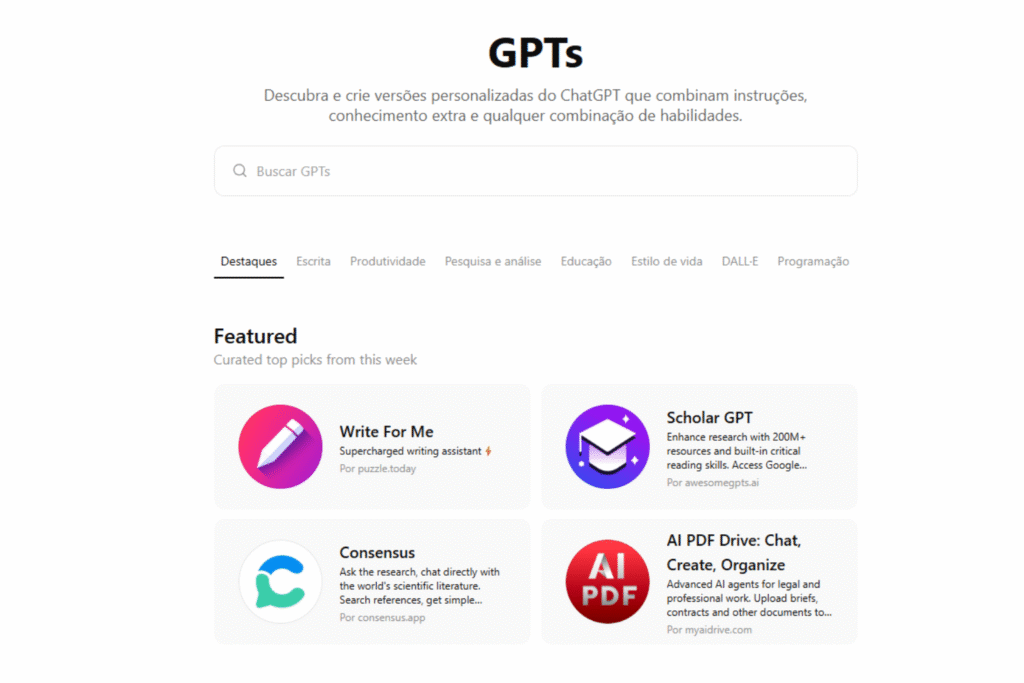
1. Access the “Explore GPTs” area.”
1. Access the “Explore GPTs” area.”

With an active ChatGPT Plus account, click on “Explore GPTs”In the sidebar menu, select the "Create" option in the upper right corner.

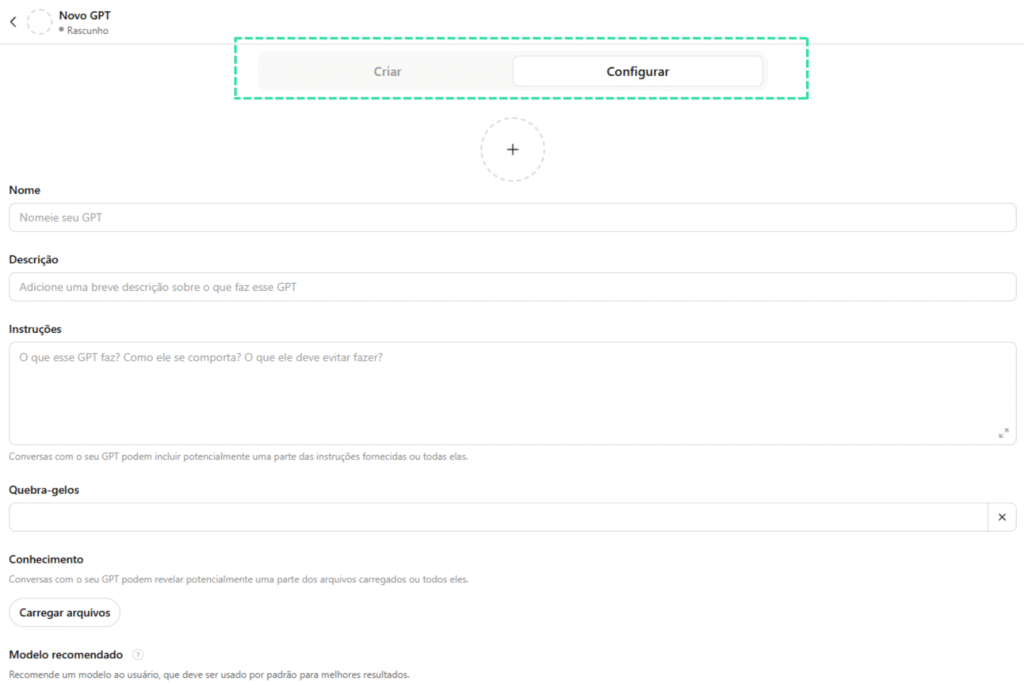
2. Choose between guided assistant or advanced mode.
2. Choose between guided assistant or advanced mode.

ChatGPT offers an interactive mode where you answer questions and it creates the agent based on your answers, or you can choose to manually set all the settings, such as name, image, behaviors, and knowledge sources.

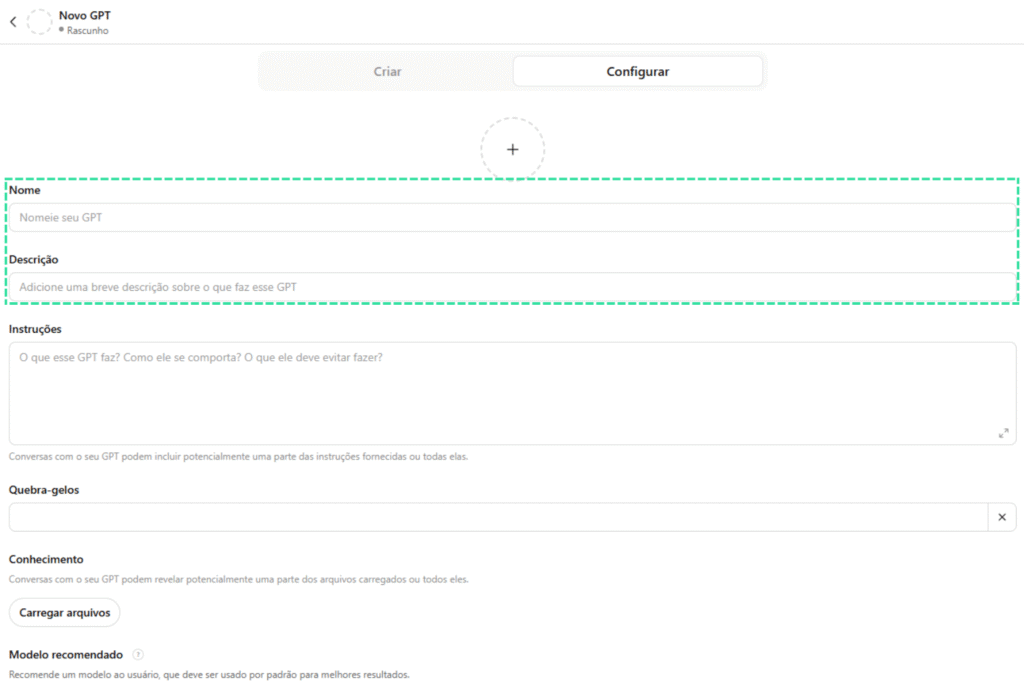
3. Configure the agent's identity.
3. Configure the agent's identity.

In this step you define the name, purpose, tone of voice, type of language, and desired behaviors. For example: "To act as a customer service representative specializing in health plans, using friendly and objective language.".

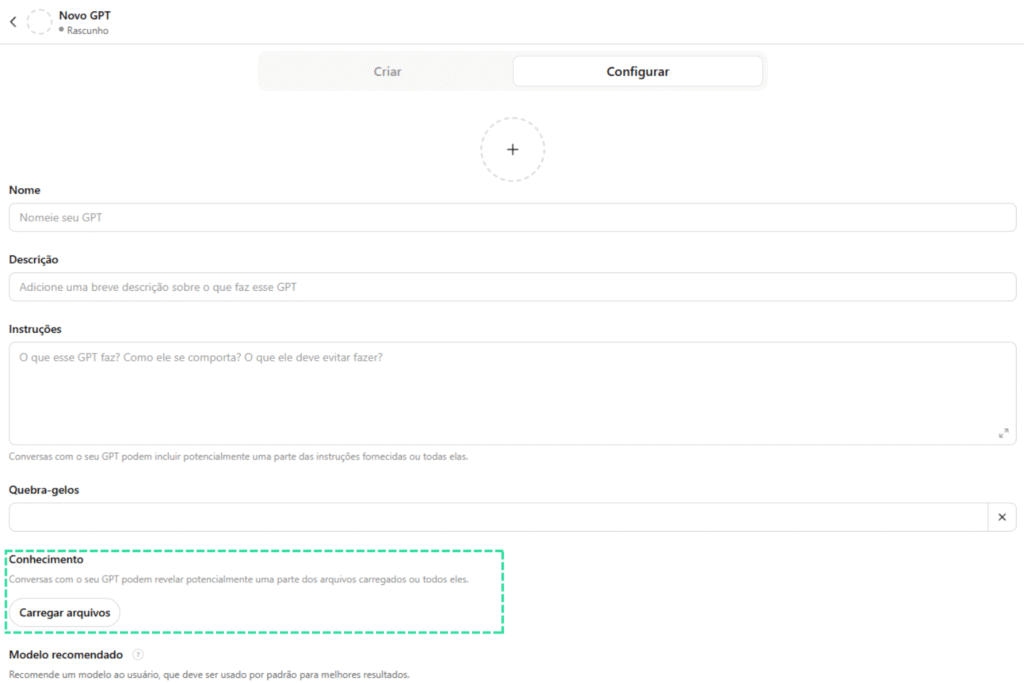
4. Add customized knowledge.
4. Add customized knowledge.

This is where the AI agent gains value. You can send PDF files, spreadsheets, knowledge bases, or insert links with public data. This allows the agent to respond accurately within the desired context.

This functionality is essential for building AI agents with technical content, such as those used in... specialized courses from No Code StartUp.

5. Define the system instructions.
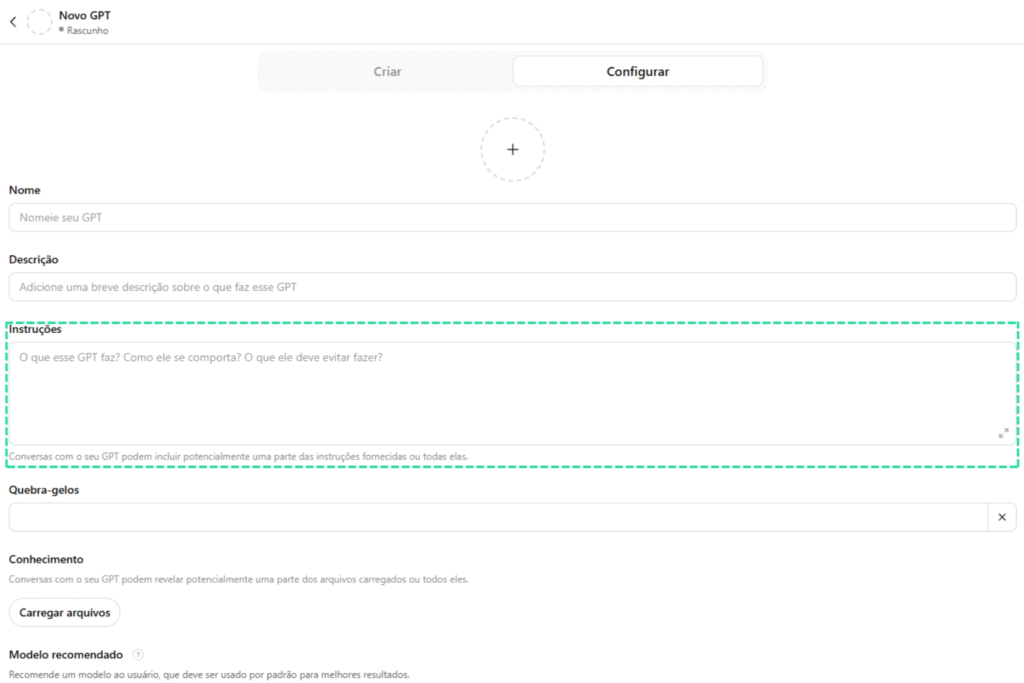
5. Define the system instructions.

The system's instructions are guidelines invisible to the user, but fundamental in shaping the agent's behavior. For example: "Do not provide answers that involve medical diagnosis," or "Prioritize solutions based on the tools taught on platform X.".

Best practices and advanced tips for effective agents.

Best practices and advanced tips for effective agents.

Creating an AI agent in ChatGPT goes beyond the initial setup. To ensure good performance and user retention, apply best practices in conversational design, such as:

Use open-ended questions to encourage interaction.

Incorporating open-ended questions into your AI agent's responses is an effective way to extend the conversation and encourage the user to provide more details. This allows for more accurate answers and a more natural experience, simulating real human interactions.

Adapt the language to the target audience based on personas.

Customizing the agent's tone of voice to match the audience profile is essential for building rapport. An agent targeting startups, for example, might use informal and objective language, while one targeting corporate environments should prioritize formality and clarity. This technique is taught in detail in [reference to a specific course/course]. AI Agent Manager Training.

Test your answers with different prompts before posting.

Before making your agent available to the public, it is recommended to test different types of questions, variations in language, and usage contexts. This practice ensures that the agent is prepared to handle multiple scenarios and avoids inadequate or limited responses.

Constantly update the agent's knowledge base.

The agent's relevance is directly linked to the timeliness and accuracy of its information. Reinforce the habit of periodically reviewing the content loaded into the agent, adding new data, removing outdated information, and improving internal instructions as actual use reveals new demands.

Complementary tools to enrich your agent.

Although ChatGPT itself offers powerful features, you can use other no-code tools to boost your agent, such as:

These tools allow you to transform your agent into a complete product, integrating it with external systems, databases, and custom front-ends.
Real-world examples of application

Real-world examples of application

At No Code StartUp, several students from SaaS IA NoCode Training They are creating AI agents to:

  • Automate customer support on landing pages.
  • Creating learning co-pilots within e-learning platforms
  • Develop SaaS MVPs with specialized assistants.
  • Build customer service funnels with data segmented by persona.

These examples demonstrate the practical potential of a well-built AI agent, with a direct impact on revenue, productivity, and scalability.

The future of personalized AI agents.

The advancement of language models and the ease of customization have made AI agents a central part of the productivity revolution. Soon, we will see the native integration of these agents into market-leading CRMs, ERPs, and apps systems.

Companies like OpenAI They have already signaled improvements in interfaces, extended context, and integrations with plugins. This opens doors for professionals without coding knowledge to develop robust AI-based products.

What you learned and how to apply it now.

Now that you know How to create an AI agent in ChatGPT, You can put this knowledge into practice to transform your business, increase your productivity, or even create a scalable digital product. Start with a simple agent, validate it with real users, and evolve iteratively.

If you want to go further and master the creation of agents with automation and AI, explore the specialized courses from [Company Name]. No Code Startup and immerse yourself in this universe with structured support.

org

Sign up for Free N8N course

The most comprehensive free N8N course you will ever take. Learn how to create your first AI Agent and automation from scratch.

Neto Camarano

Neto specialized in Bubble due to the need to create technologies quickly and cheaply for his startup, and since then he has been creating systems and automations with AI. At the Bubble Developer Summit 2023, he was listed as one of the world's leading Bubble mentors. In December, he was named the top member of the global NoCode community at the NoCode Awards 2023 and won first place in the best app competition organized by Bubble itself. Today, Neto focuses on creating AI Agent solutions and automations using N8N and OpenAI.

Also visit our Youtube channel

Learn how to create AI Applications, Agents and Automations without having to code

More Articles from No-Code Start-Up:

Straight talk: 2026 will be a game-changer for those who want to make money with... AI (Artificial Intelligence).
Opportunities exist, but not all are worth your time, and some promise much more than they deliver.

In this article, I've organized the main ways to monetize AI into clear categories, with pros, cons, and the actual level of effort involved.
The idea here is to help you choose a conscious path, without falling into illusory shortcuts.

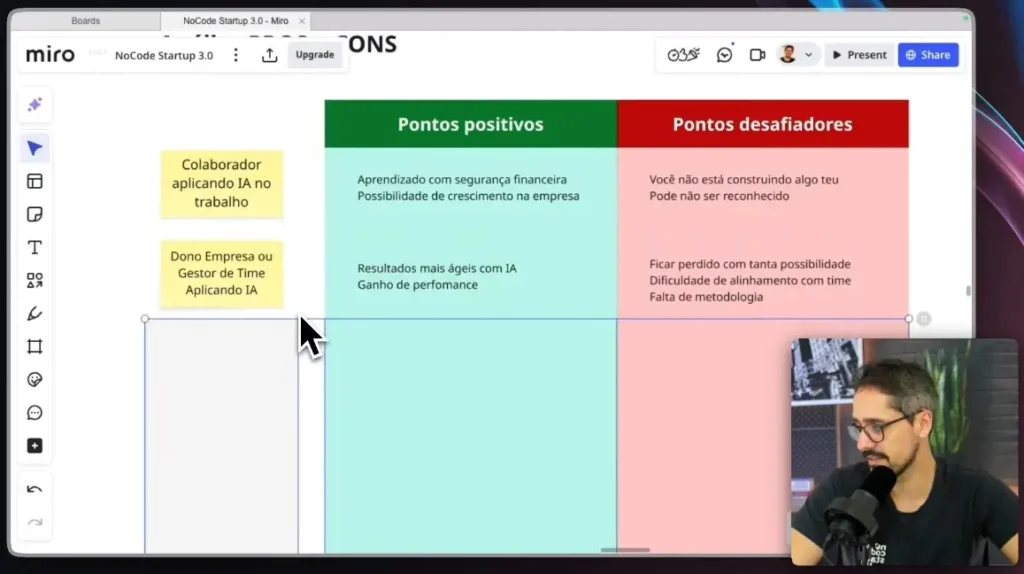
AI applied to the workplace as an employee (career and security)

If you already work for a company, applying AI to your daily routine is one of the safest ways to start.
You learn, experiment, and build real projects without sacrificing financial stability.

It's possible to create internal automations, agents, and even softwares that increase efficiency, reduce costs, and generate a direct impact on the business.
When that happens, recognition tends to follow — provided you generate real results, and not just "use AI for the sake of using it".

AI applied to the workplace as an employee (career and security)

The key point to understand is that you are not building something that is your own.
Even so, for learning and professional growth, this is one of the best entry points.

AI for managers and business owners

AI for managers and business owners

For managers and business owners, AI perhaps represents the biggest financial opportunity of 2026.
Most companies are still lost, lacking method, strategy, and clarity on how to apply AI to their processes.

When applied correctly, AI improves performance, reduces bottlenecks, and accelerates results in sales, customer service, and operations.
The challenge lies in the excess of tools and the lack of a clear methodology for the team.

Whoever manages to organize this chaos and apply AI with a focus on results will capture a lot of value.
There's a lot of money on the table here, really.

AI-powered service delivery: an overview

AI-powered service delivery: an overview.

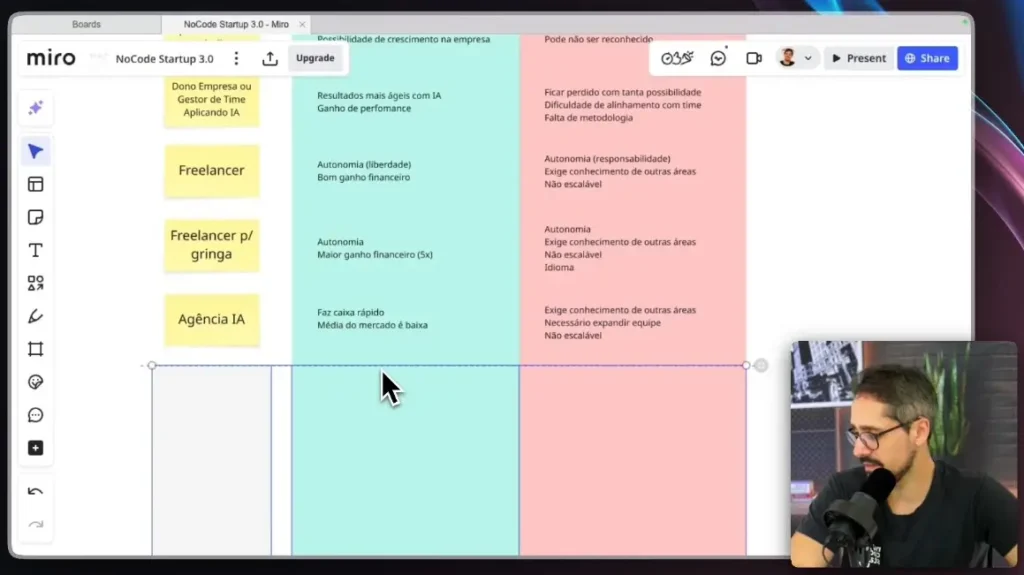
THE AI-powered service provision It's one of the fastest ways to generate income.
You solve real business problems using automation, agents, and intelligent systems.

This model unfolds into freelancer, freelancer for international clients, agency, and consultancy.
Each one has a different level of effort, return, and complexity, but all require execution.

This is where many people really start to "make the wheels turn.".

Freelancer working abroad (earning in dollars)

Freelancer working abroad (earning in dollars)

Freelancing for international companies is, without exaggeration, one of the best options for making money with AI.
Earning in dollars or euros completely changes the game.

You're still trading time for money, but with a much greater return.
The biggest challenge is the beginning: getting the first project and dealing with the language, even at a basic level.

After the first client arrives, referrals start to come in.
For those who want quick results and are willing to sell their own service, this path is extremely compelling.

Creating an AI agency

Creating an AI agency

AI agencies are the natural evolution of freelancing.
Here, you scale people, projects, and revenue.

The market is still immature; many people do everything wrong, and this creates opportunities for those who do the basics well.
You can close deals, build teams, and deliver complete solutions with AI.

The challenge then becomes management: people, deadlines, processes, and quality.
Even so, by 2026, it's one of the fastest ways to consistently monetize AI.

👉 Join the AI Coding Training Learn how to create complete prompts, automations, and AI-powered applications—going from scratch to real-world projects in just a few days.

AI consulting for businesses

AI consulting for businesses

Consulting is an extremely lucrative model, but It's not a starting point..
It requires practical experience, process understanding, and diagnostic skills.

The financial return is usually high relative to the time invested.
On the other hand, you need to have authority, a track record, and a real portfolio of projects.

For those who have experience in agencies, product development, or large-scale implementations, this is an excellent career path.
For beginners, it doesn't make sense yet.

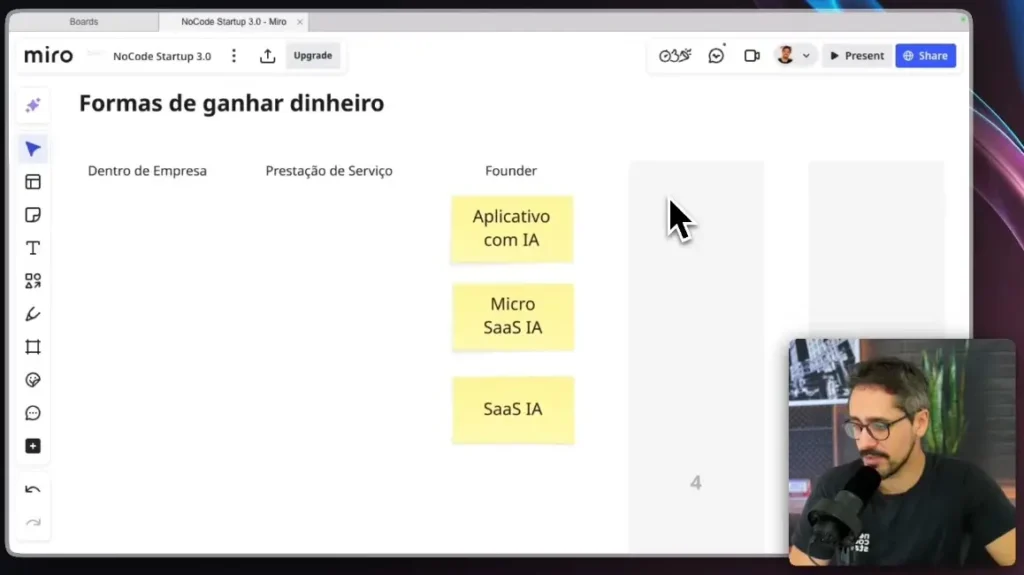
Founder: Creating AI-powered apps

Founder creating AI-powered apps

Creating AI-powered apps has never been more accessible.
Tools like Lovable, Cursor and integrations with Supabase They make this possible even without a technical background.

The financial potential is high, but so is the difficulty.
Creating technology is no longer the differentiating factor — today, the challenge lies in marketing, distribution, finance, and validation.

It's a path of great learning, but with a high error rate at the beginning.
It's worth it if you're willing to make mistakes, learn, and iterate.

Micro SaaS with AI (pros and cons)

Micro SaaS with AI (pros and cons)

O Micro SaaS It solves a specific problem for a specific niche.
This reduces competition and increases the clarity of the offer.

It doesn't scale like a traditional SaaS, but it can generate a consistent and sustainable income.
The challenge remains the same: marketing, sales, and management.

It's not easy, it's not quick, but it can be a great side business.
Here, I classify it as an "okay" path, as long as you have patience.

Traditional SaaS with AI

Traditional SaaS with AI

O SaaS traditional It has greater potential for scaling, but also greater competition.
You solve broader problems and compete in larger markets.

This requires more time, more emotional capital, and greater execution capacity.
Therefore, the Micro SaaS often ends up being a smarter choice at the beginning.

SaaS is powerful, but it's definitely not the easiest path.

AI-powered education: courses and digital products

AI-powered education courses and digital products

AI-powered education is extremely scalable.
Once the product is ready, delivery is almost automatic.

The problem is time.
Building an audience, producing content, and establishing authority takes months—sometimes years.

Here in NoCode Startup, It took us quite a while for the project to become truly financially relevant.
It works, but it requires consistency and a long-term vision.

AI Communities

AI Communities

Communities generate networking, repeat business, and authority.
But they also require constant presence, events, support, and a lot of energy.

It's a powerful, yet laborious model.
I don't recommend it as a first step for those who are just starting out.

With experience and an audience, it can become an incredible asset.

Templates, ebooks, and simple products powered by AI.

Templates, ebooks, and simple products with AI.

Templates and ebooks are easy to create and scale.
That's precisely why competition is fierce and perceived value tends to be low.

Today, if something can be solved with a question in ChatGPT, It's difficult to sell only information.
These products work best as a complement, not as a main business.

To make real money with AI, deliver execution and result That's what makes the difference.

Next step

Next step

There's no such thing as easy money with AI.
What exists is More access, more tools, and more possibilities. for those who perform well.

The most solid paths involve providing services, well-positioned products, and building authority.
The easier something seems, the greater the competition tends to be.

If you want to learn AI in a practical, structured way, focused on real-world projects, check out... AI Coding Training.

Technology is undergoing a historic transition: from passive softwares to autonomous systems. Understanding the types of AI agents It's about discovering tools capable of perceiving, reasoning, and acting independently to achieve complex goals, without the need for micromanagement.

This evolution has transformed the market. For professionals who want to lead the AI infrastructure, Mastering the taxonomy of these agents is no longer optional.

It's the exact competitive differentiator between launching a basic chatbot or orchestrating a complete digital workforce.

In this definitive guide, we'll dissect the anatomy of agents, exploring everything from classic classifications to modern LLM-based architectures that are revolutionizing the No-Code and High-Code worlds.

Diagram illustrating the perception, reasoning, and action loop of different types of AI agents in a digital environment.

What exactly defines an AI agent?

Before we explore the types, it's crucial to draw a clear line in the sand. An artificial intelligence agent is not merely a language model or a machine learning algorithm.

The most rigorous definition, accepted both in academia and industry, as in the course Stanford CS221, describes an agent as a computational entity situated in an environment, capable of perceiving it through sensors and acting upon it through actuators to maximize its chances of success.

The Crucial Difference: AI Model vs. AI Agent

Many beginners confuse the engine with the car.

  • AI model (ex: GPT-4, Llama 3): It's the passive brain. If you don't send a prompt, it does nothing. It has knowledge, but no agency.
  • AI Agent: It's the complete system. It has the model as its core reasoning tool, but it also has memory, access to tools (databases, APIs, browsers), and, crucially, a goal.

An agent uses the model's predictions to make sequential decisions, manage states, and correct the course of its actions.

It's the difference between asking ChatGPT "how to send an email" (Template) and having a software that autonomously writes, schedules, and sends the email to your contact list (Agent).

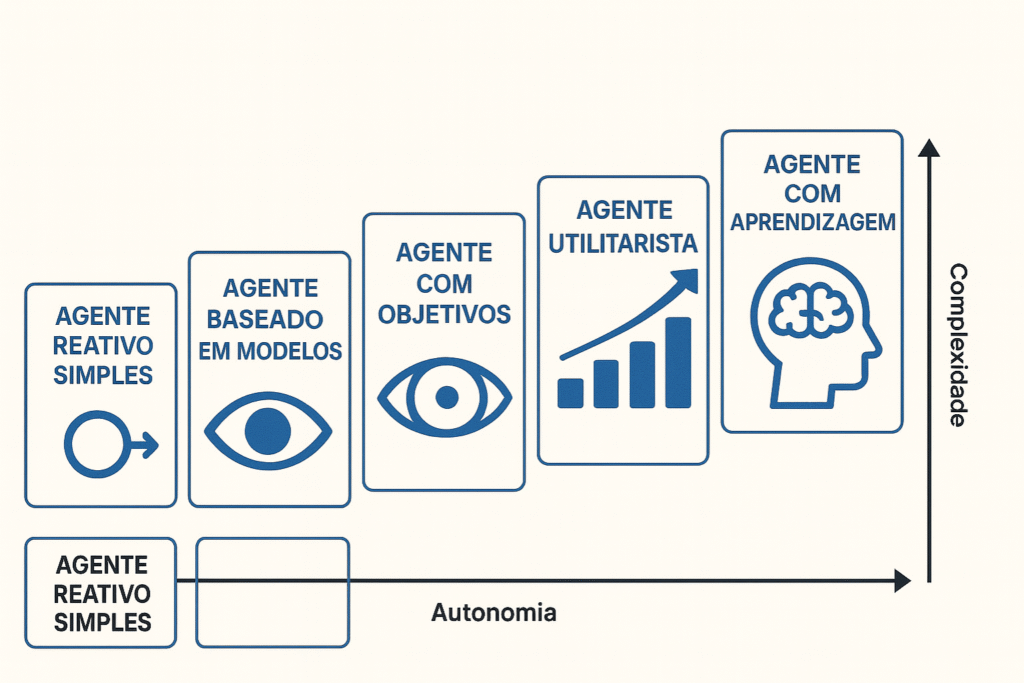
The 5 Classic Types of AI Agents

To build robust solutions, we need to revisit the theoretical foundation established by Stuart Russell and Peter Norvig, the fathers of modern AI.

The complexity of an agent is determined by its ability to handle uncertainties and maintain internal states.

Here are the 5 types of AI agents hierarchical structures that form the basis of any intelligent automation:

1. Simple Reactive Agents

This is the most basic level of intelligence. Simple reactive agents operate on the "if-then" principle.

They only respond to the current input, completely ignoring history or past states.

  • How it works: If the sensor detects "X", the actuator does "Y".
  • Example: A smart thermostat or a basic spam filter. If the temperature exceeds 25ºC, it turns on the air conditioning.
  • Limitation: They fail in complex environments where the decision depends on a historical context.

2. Model-Based Reactive Agents

Taking it a step further, these agents maintain an internal state — a kind of short-term memory.

They don't just look at the "now," but consider how the world evolves independently of their actions.

This is vital for tasks where the environment is not fully observable. For example, in a self-driving car, the agent needs to remember that there was a pedestrian on the sidewalk 2 seconds ago, even if a truck momentarily blocked its view.

3. Goal-Based Agents

True intelligence begins here. Goal-oriented agents don't just react; they plan.

They have a clear description of a "desirable" state (the goal) and evaluate different sequences of actions to achieve it.

This introduces search and planning capabilities. If the goal is to "optimize the database," the agent can simulate various paths before executing the final command, something essential for those working with... AI for data analysis.

4. Utility-Based Agents

Often, achieving the goal is not enough; it is necessary to achieve it in the best possible way. Utility-based agents use a utility function (score) to measure preference between different states.

If a logistics agent aims to deliver a package, the utility agent will calculate not only the route that gets there, but the fastest route, using the least amount of fuel and with the greatest safety. It's about maximizing efficiency.

5. Agents with Learning

At the top of the classic hierarchy are the agents capable of evolving. They have a learning component that analyzes feedback from their past actions to improve their future performance.

They start with basic knowledge and, through exploration of the environment, adjust their own decision rules. This is the principle behind advanced recommendation systems and adaptive robotics.

Infographic comparing the complexity and autonomy of five classic AI agent types, from simple reactive to learning agents.

What are generative agents based on LLMs? 

Classical taxonomy has evolved. With the arrival of the Big Language Models (LLMs), a new category has emerged that dominates current discussions: Generative Agents.

In these systems, the LLM acts as the central controller or "brain," using its vast knowledge base to reason about problems that were not explicitly programmed, as detailed in the seminal paper on... Generative Agents.

Reasoning Frameworks: ReAct and CoT

For an LLM to function as an effective agent, we utilize techniques of prompt engineering advanced principles that structure the model's thinking:

  1. Chain-of-Thought (CoT): The agent is instructed to break down complex problems into intermediate steps of logical reasoning ("Let's think step by step"). Research indicates that this technique... It stimulates complex reasoning. in large models.

  2. ReAct (Reason + Act): This is the most popular architecture currently. The agent generates a thought (Reason), executes an action on an external tool (Act), and observes the result (Observation). This loop, described in the paper... ReAct: Synergizing Reasoning and Acting, This allows it to interact with APIs, read documentation, or execute Python code in real time.

Tools like AutoGPT and BabyAGI They popularized the concept of autonomous agents that create their own task lists based on these frameworks.

You can explore the original code of AutoGPT on GitHub or from BabyAGI to understand the implementation.

Tip in Specialist: For those who wish to delve deeper into the technical design of these systems, our AI Coding Training It explores exactly how to orchestrate these frameworks to create intelligent softwares.

Architectures: Single Agent vs. Multi-Agent Systems

When developing a solution for your company, you will face a critical architectural choice: should you use a super agent that does everything or multiple specialists?

What is the difference between Single Agent and Multi-Agent Systems?

The difference lies in form of organization of intelligence.
One Single Agent It concentrates all the logic and execution into a single entity, making it simpler, faster, and easier to maintain, ideal for straightforward tasks with a well-defined scope.

Already the Multi-Agent Systems They distribute the work among specialized agents, each responsible for a specific function.

This approach increases the ability to solve complex problems, improves the quality of results, and facilitates the scalability of the solution.

When should you use a Single Agent?

A single agent is ideal for linear, narrow-scope tasks. If the goal is "summarize this PDF and send it by email," a single agent with the right tools is efficient and easy to maintain.

Latency is lower and development complexity is reduced.

The Power of Multi-Agent Orchestration

For complex problems, the industry is migrating to Multi-Agent Systems (MAS). Imagine a digital agency: you don't want the copywriter to do the design and approve the budget.

Recent technical discussions, such as this one Single vs Multi-Agent debate, They show that specialization trumps generalization.

In a multi-agent architecture, you create:

  • A "Researcher" agent that searches for data on the web.
  • An "Analyst" agent that processes the data.
  • An agent called "Writer" who creates the final report.
  • A "Critical" agent who reviews the work before delivery.

This specialization mimics human organizational structures and tends to produce higher quality results.

Modern frameworks facilitate this orchestration, such as LangGraph for complex flow control, the CrewAI for teams of role-based agents, and even lighter libraries such as Hugging Face smolagents.

Visual representation of a multi-agent system where specialized agents collaborate to solve a complex business problem.

Practical Applications and No-Code Tools

The theory is fascinating, but how does this translate into real value? Different types of AI agents are already operating behind the scenes of large, agile startups operations.

Coding and Development Agents

Autonomous agents such as Devin or open-source implementations such as OpenDevin They utilize planning architectures and tools to write, debug, and deploy entire codebases.

In the No-Code environment, tools such as FlutterFlow and Bubble They are integrating agents that assist in building complex interfaces and logic using only text commands.

Data Analytics Agents

Instead of relying on analysts to generate manual SQL reports, utility- and goal-oriented agents can connect to your data warehouse, formulate queries, analyze trends, and generate proactive insights.

This democratizes access to high-level data.

Solutions for Businesses

For the corporate sector, the implementation of AI-powered automation solutions It focuses on operational efficiency.

Customer service agents (Customer ExperienceAgents who not only answer questions but also access the CRM to process reimbursements or change plans are examples of goal-oriented agents that generate immediate ROI.

Companies like Zapier and the Salesforce They already offer dedicated platforms for creating these corporate assistants.

Interface of a business dashboard displaying performance metrics optimized by autonomous AI agents.

Frequently Asked Questions about AI Agents

Here are the most common questions we receive from the community, which dominate searches on Google and in forums like... Reddit:

What is the difference between a chatbot and an AI agent?

A traditional chatbot typically follows a rigid script or simply responds based on trained text.

An AI agent has autonomy: it can use tools (such as a calculator, calendar, email) to perform real-world tasks, not just converse.

What are autonomous agents?

These are systems that can operate without constant human intervention. You define a broad objective (e.g., "Discover the 5 best SEO tools and create a comparison table"), and the autonomous agent decides which websites to visit, what data to extract, and how to format the results on its own.

Do I need to know how to program to create an AI Agent?

Not necessarily. While knowledge of logic is vital, modern platforms and No-Code frameworks allow the creation of powerful agents through visual interfaces and natural language.

For advanced customizations, however, understanding the logic of AI Coding That's a huge advantage.

Futuristic concept of human-AI collaboration, where developers orchestrate multiple types of AI agents in a digital work environment.

The Future is Agentic — And It Requires Architects, Not Just Users

Understanding the types of agents AI It's the first step in moving from being a consumer of technology to being a creator of solutions.

Whether it's a simple reactive agent for email triage or a complex multi-agent system for managing e-commerce operations, digital autonomy is the new frontier of productivity.

The market is no longer just looking for those who know how to use ChatGPT, but those who know... designing workflows that ChatGPT (and other models) will execute.

If you want to move beyond theory and master building these tools, the ideal next step is to learn about our... AI Agent Manager Training. The era of agents has only just begun — and you could be in charge of it.

If you are looking to create more advanced projects, with better security, greater scalability, and more professionalism using the tools of Vibe Coding, This guide is for you.

In this article, I've outlined three very important tips that will guide you from beginner to advanced and truly professional projects.

We need to go beyond a simple visual interface and build a solid architecture. Let's go!

Why combine Lovable, N8N, and Supabase?

Tip 1: Starting by focusing on the main pain point

best ai app builder vibe coding platform​

My first piece of advice is to start with Lovable, but focus on simpler, more direct projects, addressing the pain points you want to solve with technology.

Be a SaaS, one Micro SaaS Whether it's an app or an application, find out what the main pain point is for your end user.

It's crucial to avoid the mistake of including "a million features, a million metrics," and complex business rules right from the start. This confuses the user and will almost certainly cause the project to fail.

Focus on creating in Lovable He creates very beautiful and visually appealing apps interfaces. Solve the main pain point first, and only then can you make the project more complex.

Case

best vibe coding apps​ (2)

A very interesting example, and one of Lovable's main case studies, is... Plink.

Basically, it's a platform where women can check if their boyfriend has had any run-ins with the police or has a history of aggression.

The creator, Sabrina, became famous because she created the app without knowing any code, focused on the main pain point, and the app simply "exploded.".

In just two months, the project was already projecting $2.2 million in revenue. She validated the idea on Lovable, proving that market focus is what makes a project successful.

Another example is an AI agent management application. We always start with the interface in Lovable and only then migrate the project to [the other platform/tool]. Cursor to make it more advanced and complex.

Master Supabase, the heart of advanced projects.

top ai app builder with vibe coding​

The second tip, and the most important for security and scalability, is to thoroughly learn the Supabase component. This encompasses data modeling and all back-end functions.

To create AI projects, you'll need the front-end (the user interface, like in Lovable) and the back-end (the intelligence, data, security, and scalability).

The back-end uses the N8N for automation and AI agents, but it is the Supabase which will be the heart of your project.

If you want a highly secure and scalable project, the secret is to master Supabase.

Courses for Beginners:

The great advantage is that, if the interface created by Lovable has a problem, since you already have the core of your project well structured, you can simply remove Lovable and plug the data into another interface, such as Cursor.

You don't need to be a technician, but you need to understand the... MacroHow data modeling, security (RLS), and data connection work.

Understanding these basics is crucial for you to be able to request and manage AI effectively. For this, I recommend our course. Supabase Course in the PRO subscription.

Tip 3: When to move on to Cursor/AI-powered code editors

best vibe coding apps

The third tip is about taking the next step: migrating to AI-powered code tools and editors, such as... Cursor or Cloud Code.

It's very important to start with Lovable in a simplified way, but if you want to make your project more advanced, robust, and scalable, you'll need to combine the organization of your back-end in Supabase with the greater control offered by these tools.

However, it is essential to understand that knowing well the Supabase It's a prerequisite before jumping into the... Cursor, Because you need to have the database and architecture very well organized.

For complex projects, this union is key to having complete control over the code and structure.

Get to know the AI Coding TrainingMaster prompt creation, build advanced agents, and launch complete applications in record time.

en_USEN
menu arrow

Nocodeflix

menu arrow

Community